Food Engineering Progress
Korean Society for Food Engineering
Reaserch article

아마인유 및 님유 기반 바이오 폴리올을 이용한 폴리우레탄 폼 제조 및 폼의 메추리알 보호 포장재로서의 적용

하예은1https://orcid.org/0009-0007-8478-6440, 명가은1https://orcid.org/0009-0008-4954-2595, 유영선2https://orcid.org/0000-0002-5820-1855, 김장원3, 김성황4, 민세철1,*https://orcid.org/0000-0003-1312-358X
Ye Eun Ha1https://orcid.org/0009-0007-8478-6440, Ga Eun Myung1https://orcid.org/0009-0008-4954-2595, Young-Sun You2https://orcid.org/0000-0002-5820-1855, Noah Kim3, Seong-Hwang Kim4, Sea Cheol Min1,*https://orcid.org/0000-0003-1312-358X
1서울여자대학교 식품공학과
2(주)바이오소재
3이아이씨티 코리아
4ECO융합섬유연구원
1Department of Food Science and Biotechnology, Seoul Women’s University, Seoul 01797, Korea
2Bio Polymer Co., Ltd., Bucheon 14786, Korea
3EICT Korea Co., Ltd., Hwaseong 18449, Korea
4Korea Institute of Convergence Textile, Iksan 54588, Korea
*Corresponding author: Sea Cheol Min, Department of Food Science and Biotechnology, Seoul Women’s University, Seoul 01797, Korea, E-mail: smin@swu.ac.kr

© Copyright 2026 Korean Society for Food Engineering. This is an Open-Access article distributed under the terms of the Creative Commons Attribution Non-Commercial License (http://creativecommons.org/licenses/by-nc/4.0/) which permits unrestricted non-commercial use, distribution, and reproduction in any medium, provided the original work is properly cited.

Received: Oct 06, 2026; Revised: Oct 30, 2026; Accepted: Oct 31, 2026

Published Online: Nov 18, 2026

Abatract

Bio-based polyurethane foams (PUFs) were prepared using bio-polyols synthesized from linseed and neem oils, and their properties were characterized. Polyols were synthesized from neem oil via transesterification (pOH_NO_T) and from linseed oil via transesterification (pOH_LO_T) or epoxidation (pOH_LO_E). After synthesis, the hydroxyl values increased (54.5–253.3 mg KOH/g) and the iodine values decreased (38.4–179.7 g I2/100 g), whereas acid values and colors varied with oil type and synthesis method. The hydroxyl and urethane bands confirmed polyol synthesis and foam formation. The pOH_LO_E-based foam (PUF_LO_E) showed higher tensile strength (40.3 kPa) and compressive strength (6.0 MPa) than the pOH_LO_T-based (PUF_LO_T) and pOH_NO_T-based (PUF_NO_T) foams. PUF_LO_E and PUF_LO_T exhibited higher tear strength (5.5 kN/m), lightness (78.9 and 77.3), and water contact angle (100.9° and 99.8°) than PUF_NO_T, whereas elongation at break did not differ among foams (p>0.05). PUF_LO_E had a lower apparent density (43.6 kg/m3) than the other foams. In repeated-drop tests using quail eggs, eggs packaged with PUF_LO_T and PUF_NO_T fractured after 25 drops, whereas those packaged with PUF_LO_E fractured after 480 drops. These findings demonstrate that bio-polyols synthesized from linseed and neem oils can be used to prepare bio-based polyurethane foams with potential as alternatives to conventional polyurethane foams.

Keywords: Non-edible vegetable oil; Glycerolysis; Hydroxylation; Sustainability; Packaging

서 론

폴리우레탄(polyurethane)은 우수한 열적 및 기계적 특성과 함께 유연성, 강성, 그리고 경량성을 갖춘 고분자로, 폼(foam), 코팅, 엘라스토머(elastomer), 그리고 접착제 등 다양한 분야에 활용된다(Delavarde et al., 2024). 이중 폴리우레탄 폼은 전체 폴리우레탄 사용량의 약 65%를 차지하며, 기계적 특성과 코어(core) 밀도에 따라 연질 폼과 경질 폼으로 분류된다(Wu & Chen, 2025; Rossi et al., 2026). 식품 산업에서 연질 폼은 신선 과채류를 외부 충격으로부터 보호하는 완충재로 사용되며, 경질 폼은 저온 유통 시스템에서 열 이동을 차단하는 단열재로 활용된다(Tinti et al., 2014; Fan et al., 2024). 이러한 활용성을 바탕으로, 폴리우레탄 폼 시장은 2028년까지 전 세계적으로 약 678억 달러 규모로 성장할 것으로 전망된다(Grignard et al., 2026).

폴리우레탄 폼은 폴리올(polyol)과 이소시아네이트(isocyanate)의 반응으로 우레탄 결합이 형성되는 동시에, 이소시아네이트와 물과의 반응에서 발생한 기체에 의해 발포되어 제조된다(Gama et al., 2018). 이때 사용되는 폴리올과 이소시아네이트는 대부분 석유 유래 자원으로부터 생산된다. 그러나 석유 기반 원료는 자원이 한정적이고 환경 문제를 유발할 수 있다는 한계가 있다. 이에 따라 식물유, 전분, 그리고 리그닌 등 재생 가능한 자원으로 석유 기반 원료를 대체하는 폼 개발 연구가 활발히 진행되고 있다(Agrawal et al., 2017; Eling et al., 2020; Mo et al., 2024). 그중 식물유는 비교적 저렴하고 안정적인 수급이 가능하다는 점에서 바이오 기반 폴리올 합성 원료로 주목받고 있다(Członka et al., 2018; Kaikade & Sabnis, 2023).

그러나 대부분의 식물유는 이소시아네이트와 반응할 수 있는 수산기를 함유하지 않아 폴리우레탄 합성에 직접 사용되기 어렵다. 따라서 식물유를 폴리올 원료로 활용하기 위해서는 화학 반응을 통해 구조를 변환해야 하며, 대표적인 화학 반응으로는 에폭시화 반응(epoxidation), 하이드로포밀화 반응(hydroformylation), 오존분해 반응(ozonolysis), 에스테르교환 반응(transesterification), 그리고 티올-엔 반응(thiol-ene coupling)이 있다(Nia & Nikje, 2025; Santos et al., 2025).

식용 식물유는 식품뿐 아니라 바이오 기반 소재의 원료로도 활용되므로, 산업적 이용이 증가할 경우 식품 생산과의 원료 수급 경쟁이 발생할 수 있다. 반면 비식용 식물유는 식품으로 직접 이용되지 않으므로 이를 바이오 기반 소재의 원료로 활용할 경우 식량 자원과의 경쟁을 줄일 수 있다(Atabani et al., 2013; Malewska et al., 2023). 폴리올 합성에 활용되는 비식용 식물유에는 아마인유(Linseed oil), 님유(Neem oil), 피마자유(Castor oil), 호호바유(Jojoba oil), 그리고 자트로파유(Jatropha oil) 등이 있다(Patil et al., 2021). 이중 아마인유는 아마씨에서 추출되는 고불포화 건성유로, α-리놀렌산을 비롯한 불포화 지방산을 70% 이상 함유한다(Calvo-Correas et al., 2015). 이처럼 이중결합 함량이 높은 조성은 에폭시화 반응을 통한 수산기 도입에 유리하다(Janković et al., 2020). 반면 님유는 고온·건조한 환경에서도 생육이 가능한 님 나무의 종자로부터 얻어지므로 원료 확보가 용이하며(Campos et al., 2016), 올레산과 리놀레산을 포함한 불포화 지방산을 약 55% 함유한다. 아마인유와 님유는 모두 트리글리세리드 구조를 가지므로, 에스테르교환반응을 통해 폴리올로 전환될 수 있다(Liao et al., 2021). 따라서 본 연구의 목적은 1) 아마인유와 님유를 이용하여 비식용 식물유 기반 폴리올을 합성하고, 2) 식물유와 합성된 바이오 폴리올의 Fourier transform infrared spectroscopy (FTIR), 산가, 요오드가, 수산기가, 그리고 색도를 분석하는 것이었으며, 3) 합성된 폴리올을 이소시아네이트와 반응시켜 바이오 기반 폴리우레탄 폼을 제조하고, 4) 제조한 바이오 기반 폴리우레탄 폼의 FTIR, 인장강도, 신장률, 인열강도, 압축강도, 겉보기 밀도, 색도, 그리고 접촉각을 분석하며, 그리고 5) 메추리알을 이용한 반복 낙하 시험을 통해 제조된 폴리우레탄 폼의 식품 보호 성능을 평가하는 것이었다.

재료 및 방법

재료

본 연구에서 사용한 아마인유는 대정화금(Siheung, Korea)에서 구매하였으며, 님유는 자연의숲(Bucheon, Korea)에서 구매하였다. 바이오 폴리올 합성을 위한 에폭시화 반응에는 30% 과산화수소(Sigma-Aldrich, St. Louis, MO, USA)와 포름산(Samchun Chemical Co., Ltd., Seoul, Korea)을 사용하였으며, 에스테르교환반응에는 글리세롤 99.0% (Samchun Chemical Co., Ltd.)와 산화칼슘(Daejung Chemicals & Metals Co., Ltd., Siheung, Korea)을 사용하였다.

폴리우레탄 폼 제조에는 합성된 바이오 폴리올과 상용 폴리에스터 폴리올(Pol-6001, Aekyung Chemical Co., Ltd., Seoul, Korea)을 사용하였다. 우레탄 구조 형성을 위해 이소시아네이트(M-200, Kumho Mitsui Chemicals, Seoul, Korea), 상분리 억제제로 흄드 실리카(Fumed silica; Aerosil® R 972, Evonik Korea, Seoul, Korea), 기포 안정제로 실리콘 계면활성제(Ak-8803, Jiangsu Maysta Chemical Co., Ltd., Nanjing, China), 화학적 발포제로 증류수, 그리고 반응 촉매로 3차 아민 촉매인 2-(2-(Dimethylamino)ethoxy)ethanol (Hebei Mingxu Chemicals Co., Ltd., Hebei, China)을 사용하였다.

낙하 시험에 사용된 메추리알(Join Co., Ltd., Eumseong, Korea)은 구입 후 약 2개월간 냉장 보관한 후 실험에 사용하였다. 메추리알의 평균 질량, 길이, 그리고 폭은 각각 10.66±0.08 g, 28.7±0.6 mm, 그리고 23.3±0.6 mm였다.

바이오 폴리올 합성

본 연구에서는 에폭시화 반응과 에스테르교환반응을 이용하여 식물유로부터 바이오 폴리올을 합성하였다. 아마인유의 에폭시화 반응은 Calvo-Correas et al. (2015)의 방법을 참고하여 수행하였다. 과산화수소 29.53 g과 포름산 19.74 g을 준비한 후, 플라스크에 점적하면서 교반하여 혼합하였다. 혼합물을 40℃에서 5분간 반응시킨 후 아마인유 50 g을 점적 첨가하였다. 아마인유 첨가 후 반응 온도를 50℃로 높이고, 해당 온도에서 3시간 30분 동안 교반하여 에폭시화 반응을 유도하였다. 반응 종료 후 혼합물을 실온에 방치하여 23±2℃까지 냉각시킨 다음, 분액깔때기를 이용해 약 12시간 동안 상분리하였다. 이후 상층을 회수하여 증류수로 세척하였으며, 열풍건조기(JSOF-150, JS Research Inc., Gongju, Korea)를 이용해 80℃에서 3시간 동안 건조하여 잔류 수분과 산을 제거하였다.

아마인유와 님유의 에스테르교환반응은 각각 Chang et al. (2018)과 Liao et al. (2021)의 방법을 참고하여 수행하였다. 아마인유 100 g과 글리세롤 10.52 g 그리고 님유 100 g과 글리세롤 30.60 g을 각각 4구 플라스크에 준비하였다. 각 플라스크에 질소 주입관, 환류냉각기, 온도계, 그리고 교반기를 장착하였으며, 질소 가스(0.05 MPa)를 주입하면서 혼합물을 가열하였다. 아마인유 혼합물과 님유 혼합물의 온도가 각각 200℃와 220℃에 도달하였을 때 산화칼슘 촉매를 각각 0.22 g과 0.20 g 첨가하였다. 이후 각 혼합물을 해당 온도에서 600 rpm으로 3시간 동안 교반하여 에스테르교환반응을 유도하였다. 반응 종료 후 각 혼합물을 23±2℃까지 냉각한 다음, 분액깔때기로 상분리하고 상층액을 회수하였다. 회수한 상층액은 열풍건조기를 이용해 80℃에서 3시간 동안 건조하여 잔류 수분을 제거한 후 폴리올로 사용하였다. 각 폴리올의 수율은 Khalid et al. (2025)의 방법을 참고하여, 반응에 사용한 식물유 질량에 대한 최종 폴리올 생성물 질량의 비율로 계산하였다.

Y i e l d ( % ) = M a s s   o f   t h e   f i n a l   p l y o l   p r o d u c t   ( g ) M a s s   o f   o i l   t a k e n   ( g ) × 100
식물유와 바이오 폴리올 특성 분석

FTIR 분석은 spectrometer (Spectrum 100, PerkinElmer, Waltham, MA, USA)를 이용하여 attenuated total reflectance (ATR) mode에서 수행하였다(Favero et al., 2019). 산가는 식품공전의 일반시험법(MFDS, 2025)에 따라 측정하였으며, 요오드가와 수산기가는 각각 ASTM D5554 (ASTM, 2021)와 ASTM D4274 (ASTM, 2023)에 따라 분석하였다. 색도는 colorimeter (Minolta chroma meter CR-400, Konica Minolta Inc., Tokyo, Japan)를 사용하여 CIE L*, a*, 그리고 b*값으로 측정하였다.

바이오 기반 폴리우레탄 폼 제조

폴리우레탄 폼은 Lee & Kim (2023)에 묘사된 원샷(one-shot) 방법을 통해 제조하였다. 본 연구에서는 상용 폴리에스터 폴리올의 일부를 식물유 기반 바이오 폴리올로 대체하여 폴리우레탄 폼의 제조 가능성을 평가하고자 하였으며, 이를 위해 합성된 바이오 폴리올과 상용 폴리에스터 폴리올을 질량비 1:1로 혼합하였다. 이후 혼합물에 흄드 실리카, 정포제, 발포제, 그리고 3차 아민 촉매를 첨가하여 혼합한 후, 이소시아네이트를 첨가하고 20초간 추가 혼합하였다. 각 성분의 배합비는 Table 1에 나타내었다. 혼합이 완료된 반응물은 즉시 1 L 유리 비커에 넣어 발포시켜 바이오 기반 폴리우레탄 폼을 제조하였다.

Table 1. Formulation of bio-based polyurethane foams
Material Formulation
PUF_LO_T1) (g) PUF_LO_E2) (g) PUF_NO_T3) (g)
Bio-polyols 55.3 55.3 45.5
Polyester polyol 55.3 55.3 45.5
Isocyanate 63.5 63.5 73.6
Fumed silica 1.2 1.2 1.2
Silicone surfactant 1.0 1.0 1.0
Blowing agent 5.0 5.0 5.0
Tertiary amine catalyst 0.5 0.5 0.5

PUF_LO_T: Polyurethane foams prepared from transesterified linseed oil-derived polyols.

PUF_LO_E: Polyurethane foams prepared from epoxidized linseed oil-derived polyols.

PUF_NO_T: Polyurethane foams prepared from transesterified neem oil-derived polyols.

Download Excel Table

각 폴리우레탄 폼의 isocyanate index는 Albayrak et al. (2026)의 방법에 따라 폴리올과 3차 아민 촉매의 수산기 당량, 물과의 반응에 필요한 이소시아네이트 당량, 그리고 이소시아네이트의 NCO 당량을 이용하여 계산하였다. 아마인유의 에스테르교환반응, 아마인유의 에폭시화 반응, 그리고 님유의 에스테르교환반응으로 합성된 폴리올을 사용한 각 폴리우레탄 폼 배합의 전체 수산기 당량은 각각 0.2231, 0.2959, 그리고 0.3455 eq이었으며, 물과의 반응에 필요한 NCO 당량은 모든 배합에서 0.5551 eq이었다. 이를 바탕으로 산출된 isocyanate index는 각각 61.2, 55.9, 그리고 61.3이었다.

바이오 기반 폴리우레탄 폼 특성 분석

폴리우레탄 폼의 FTIR 분석은 spectrometer를 이용하여 attenuated total reflectance (ATR) mode로 수행하였다(Favero et al., 2019). 인장강도, 인열강도, 그리고 압축강도는 Li et al. (2017)의 방법을 참고하여 측정하였다. 인장강도와 신장률은 universal testing machine (Wl2100, Withlab Co., Ltd., Gunpo, Korea)을 사용하여 측정하였으며, 시편은 100 mm×35 mm×15 mm로 준비하였다. 인열강도와 압축강도는 material test machine (P-2014, Smartlab, Anyang, Korea)을 사용하여 측정하였고, 시편는 각각 50 mm×40 mm×18 mm와 50 mm×50 mm×18 mm로 준비하였다. 시편의 겉보기 밀도는 시편의 측정된 질량을 시편의 지름(28 mm)과 높이(30 mm)로 계산된 부피로 나누어 산출되었다. 색도는 colorimeter를 사용하여 측정하였다. 접촉각은 contact angle analyzer (Phoenix-MT(T)/ Tilting, SEO, Suwon, Korea)로 증류수와 시편 표면 사이의 정적 접촉각을 측정하여 평균값으로 나타내었다.

바이오 기반 폴리우레탄 폼의 보호 성능 평가

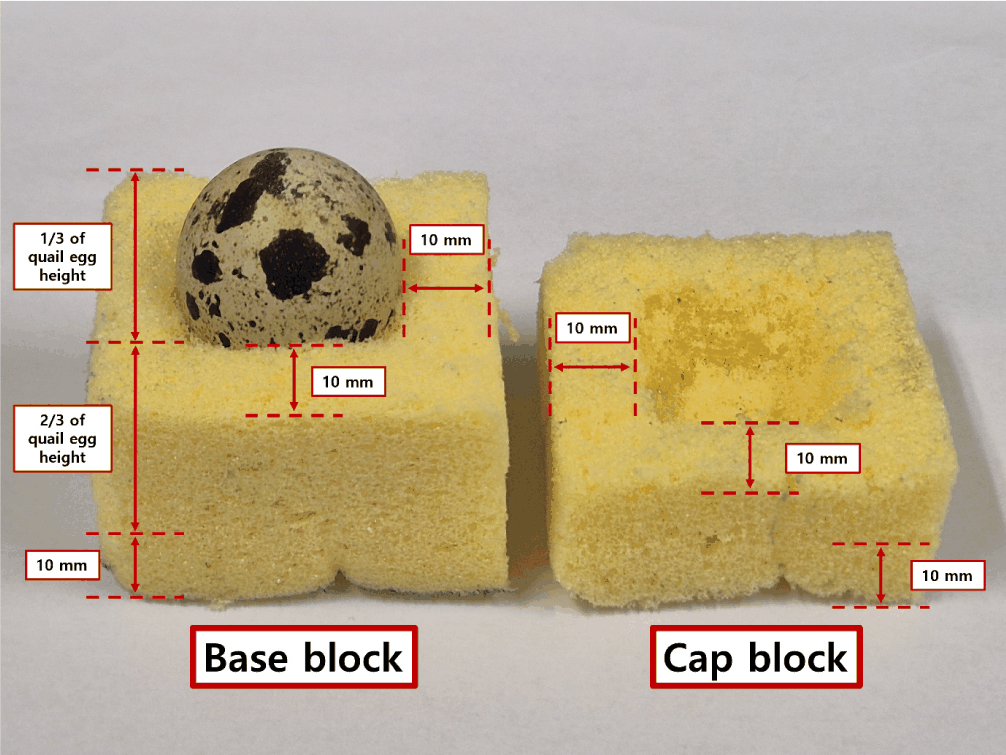
본 연구에서 제조한 바이오 기반 폴리우레탄 폼의 보호 성능을 평가하기 위하여 Fan et al. (2025)의 방법을 참고하여 반복 낙하 시험을 수행하였다. 낙하 시험용 폼 시편은 메추리알을 수용할 수 있도록 덮개 블록(cap)과 받침 블록(base)으로 구성하였다(Fig. 1). 제조된 폴리우레탄 폼을 덮개 블록과 받침 블록으로 절단한 후, 각 블록의 중앙에 메추리알의 형태에 맞는 홈을 형성하였다. 메추리알의 장축이 수직이 되도록 배치한 상태에서 메추리알 전체 높이의 1/3과 2/3이 덮개 블록과 받침 블록에 수용되도록 홈의 깊이를 설정하였다. 또한 메추리알을 둘러싼 폼의 두께가 10 mm가 되도록 시편을 제작하였다. 메추리알을 받침 블록의 홈에 넣고 덮개 블록을 덮은 후, 고무줄(길이 70 mm, 폭 1.5 mm)로 두 블록을 고정하였다. 폼으로 포장된 메추리알을 콘크리트 바닥으로부터 2 m 높이에서 자유 낙하시켰다. 낙하 후 메추리알의 파손 여부를 육안으로 확인하였으며, 메추리알의 난각이 파손되어 내용물이 외부로 유출될 때까지의 누적 낙하 횟수를 측정하여 보호 성능을 평가하였다.
fep-30-0-260043-g1
Fig. 1. Bio-based polyurethane foam packaging used for the repeated drop test of quail eggs: base block containing a quail egg (left) and cap block (right).
Download Original Figure
통계분석

바이오 폴리올의 합성과 바이오 기반 폴리우레탄 폼의 제조는 각 처리 조건에 대하여 3회 독립적으로 수행하였다(n=3). 식물유와 바이오 폴리올의 산가, 요오드가, 그리고 수산기가는 각 시료에 대하여 3회 반복 측정하였으며, 색도는 5회 반복 측정하였다. FTIR 분석은 각 반복에서 얻어진 시료에 대하여 수행하였으며, 스펙트럼의 특성 피크를 정성적으로 비교하였다. 폴리우레탄 폼의 겉보기 밀도, 인장강도, 신장률, 인열강도, 그리고 압축강도는 제조된 폼으로부터 3개의 시편을 사용하여 측정하였다. 폴리우레탄 폼의 색도는 각 시편에서 5회 반복 측정하였으며, 접촉각은 각 시편에서 3회 측정하였다. 메추리알 낙하 시험은 각 시험 당 1개의 메추리알을 사용하여 수행하였다. 실험 결과에 대하여 SPSS (Ver. 24.0.0; IBM Corp., Armonk, NY, USA)의 일원배치 분산분석(ANOVA)으로 통계적 유의성을 검정한 뒤, Tukey’s multiple range test를 이용하여 사후 검정하였다(α=0.05).

결과 및 고찰

식물유와 바이오 폴리올 특성 분석

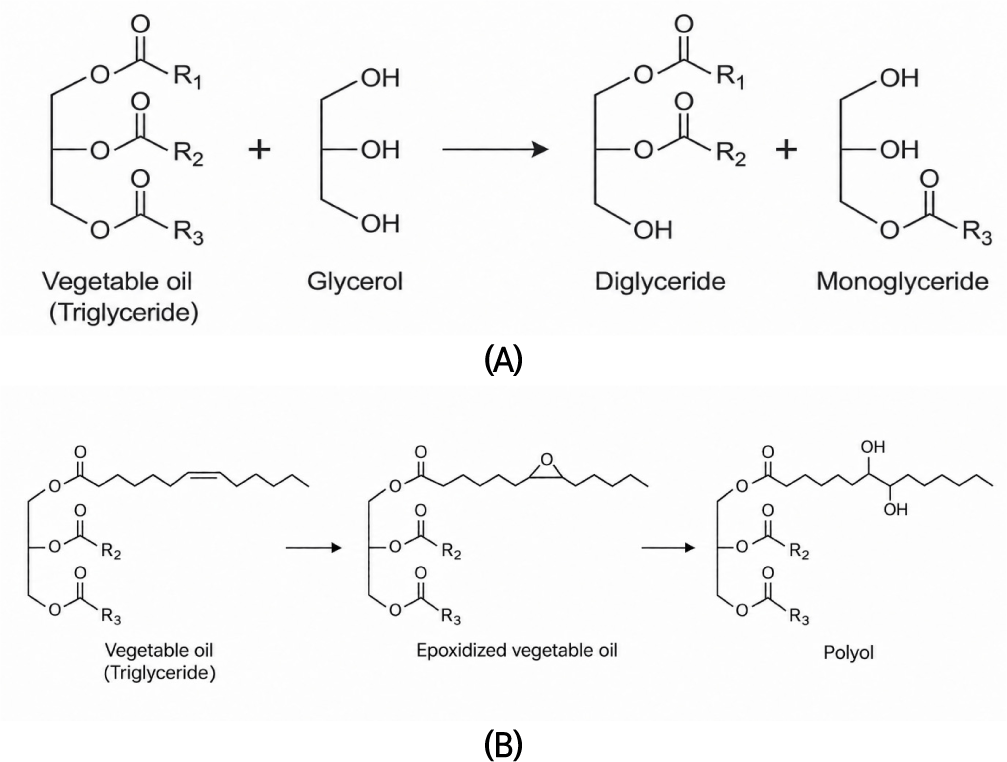
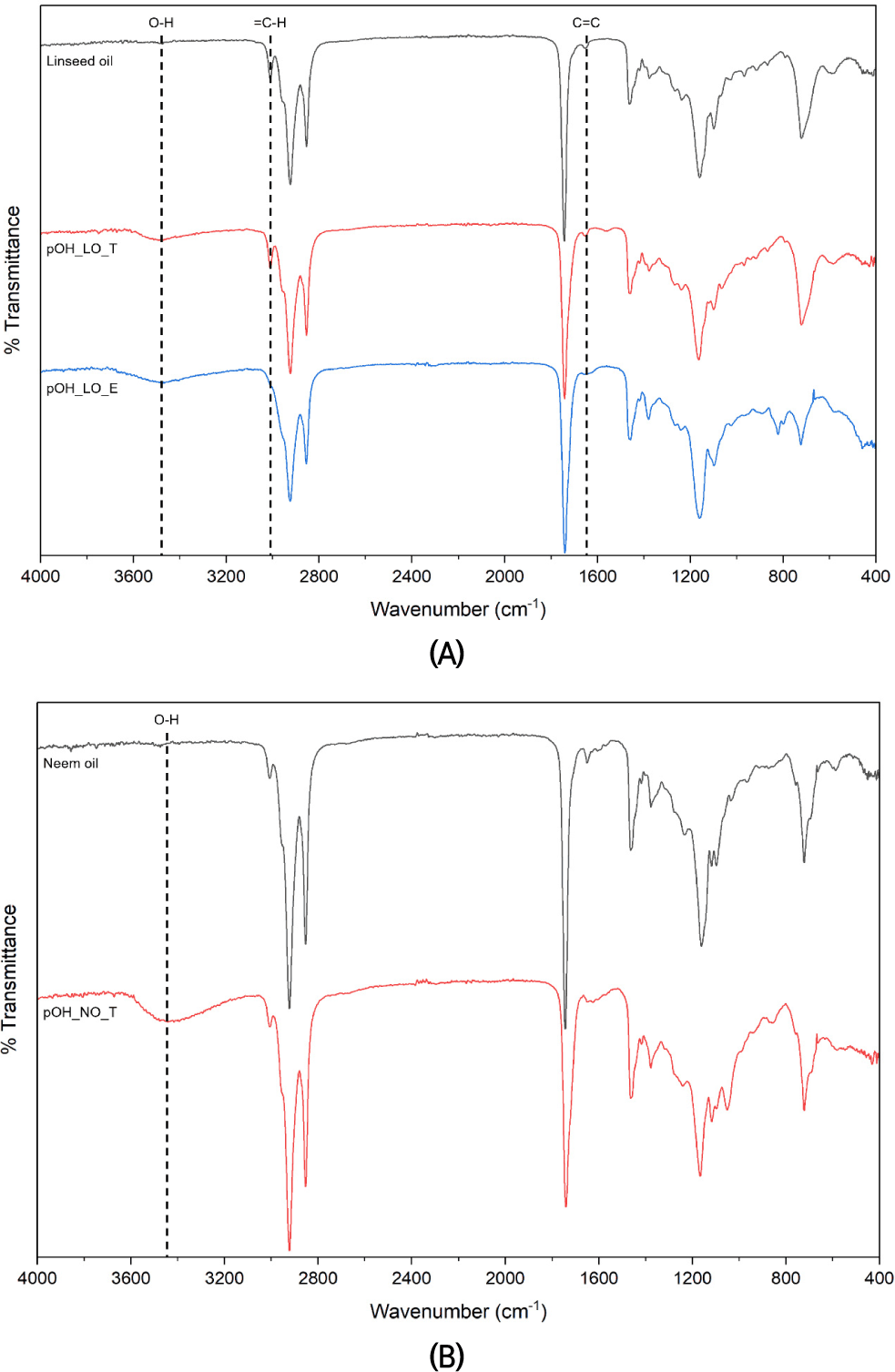
아마인유와 님유의 에스테르교환반응과 아마인유의 에폭시화 반응을 통한 바이오 폴리올의 합성 경로를 Fig. 2에 나타내었다(Calvo-Correas et al., 2015; Jayavani et al., 2017). 또한, 식물유와 이를 기반으로 합성한 바이오 폴리올의 화학적 구조 변화를 확인하기 위해 FTIR 분석을 수행하였으며, 그 결과를 Fig. 3에 나타내었다. 에스테르교환반응으로 합성한 아마인유 기반 폴리올(pOH_LO_T)과 님유 기반 폴리올(pOH_NO_T), 그리고 에폭시화 반응으로 합성한 아마인유 기반 폴리올(pOH_LO_E)에서는 모두 3,442–3,476 cm–1 영역에서 O-H 신축 진동에 해당하는 흡수 피크가 관찰되었다(Chang et al., 2018). 에스테르교환반응에서는 트리글리세리드가 글리세롤과 반응하여 수산기를 갖는 모노글리세리드와 디글리세리드로 전환되므로(Arniza et al., 2015), pOH_LO_T와 pOH_NO_T에서 관찰된 O-H 흡수 피크는 수산기의 도입을 시사한다. pOH_LO_E에서는 불포화결합과 관련된 3,010과 1,653 cm–1 영역의 피크가 감소한 반면 O-H 흡수 피크가 관찰되었다. 이를 통해 반응 과정에서 이중결합이 소모되고 수산기가 형성되었을 가능성을 확인할 수 있었다(Varghese & Gopalakrishnan, 2026).
fep-30-0-260043-g2
Fig. 2. Schematic illustrations of (A) transesterification and (B) epoxidation reactions for bio-polyol synthesis.
Download Original Figure
fep-30-0-260043-g3
Fig. 3. FTIR spectra of (A) linseed oil and bio-polyols derived from linseed oil via transesterification (pOH_LO_T) and epoxidation (pOH_LO_E), and (B) neem oil and bio-polyol derived from neem oil via transesterification.
Download Original Figure

식물유와 이를 기반으로 합성한 바이오 폴리올의 산가, 요오드가, 그리고 수산기가를 측정한 결과는 Table 2에 나타내었다. 님유의 산가는 6.0±0.4 mg KOH/g으로 아마인유의 산가(0.6±0.1 mg KOH/g)보다 높게 나타났다. 산가는 유지 내 유리지방산 함량을 나타내는 지표이므로, 님유의 높은 산가는 아마인유에 비해 상대적으로 많은 유리지방산을 함유하고 있음을 시사한다(Borowicz et al., 2025). Hamadou et al. (2020)은 님유의 산가를 7.9–9.1 mg KOH/g으로 보고하였으며, 이를 고려할 때 본 연구에서 나타난 님유의 높은 산가는 님유 자체의 높은 유리지방산 함량에서 기인한 것으로 판단된다. 또한 pOH_NO_T의 산가는 원료 님유보다 낮게 나타났다. 이는 고온에서 진행된 에스테르교환반응 과정에서 님유에 존재하던 유리지방산의 일부가 글리세롤과 에스테르화되어 유리지방산 함량이 감소했기 때문으로 판단된다(Jayavani et al., 2017). 반면, pOH_LO_T의 산가는 원료 아마인유보다 높게 나타났다. 이는 고온에서 장시간 수행된 반응 중 글리세리드 일부가 분해되어 소량의 유리지방산이 형성되었기 때문으로 생각된다(Felizardo et al., 2011). pOH_LO_E의 산가는 12.8±1.6 mg KOH/g으로 바이오 폴리올 중 가장 높은 산가를 나타냈다. 이는 에폭시화 반응에 사용된 포름산 등의 산성 성분이 세척 과정에서 완전히 제거되지 않고 일부 잔류하였거나, 반응 과정에서 트리글리세리드의 부분 가수분해로 유리지방산이 형성되었기 때문에 최종 생성물의 산가가 증가한 것으로 판단된다(Ju et al., 2020; Abolins et al., 2021; Briede et al., 2025).

Table 2. Acid values, iodine values, and hydroxyl values of vegetable oils and synthesized bio-polyols
Sample Acid value (mg KOH/g) Iodine value (g I2/100 g) Hydroxyl value (mg KOH/g)
Linseed oil 0.6±0.1e 203.3±4.7a 2.1±0.7d
Neem oil 6.0±0.4b 82.3±3.5c 3.5±1.0d
pOH_LO_T1) 1.2±0.2d 179.7±9.4b 54.5±1.7c
pOH_LO_E2) 12.8±1.6a 38.4±6.3e 128.4±0.6b
pOH_NO_T3) 3.0±0.4c 65.9±3.5d 253.3±0.9a

pOH_LO_T: Polyol derived from linseed oil via transesterification.

pOH_LO_E: Polyol derived from linseed oil via epoxidation.

pOH_NO_T: Polyol derived from neem oil via transesterification.

Means followed by the same lower-case letter within a column are not significantly different (p>0.05) based on ANOVA followed by Tukey’s multiple range test.

Download Excel Table

아마인유의 요오드가는 203.3±4.7 g I2/100 g으로 님유보다 높은 불포화도를 나타냈다. 높은 불포화도는 에폭시화 반응을 통한 수산기 도입에 유리하므로(Borowicz et al., 2025), 아마인유는 에폭시화 기반 폴리올 합성에 적합한 원료로 판단되었다. 이에 본 연구에서는 아마인유 기반 폴리올을 에스테르교환반응과 에폭시화 반응을 이용하여 각각 합성하였다. 합성된 pOH_LO_E의 요오드가(38.4±6.3 g I2/100 g)는 원료 아마인유보다 낮게 나타났는데, 이는 합성 과정에서 아마인유의 이중결합이 소모되었음을 보여주며, 에폭시화 반응이 진행되었음을 시사한다(Calvo-Correas et al., 2015).

아마인유와 님유의 수산기가는 각각 2.1±0.7, 3.5±1.0 mg KOH/g으로 나타났으며, pOH_LO_T, pOH_LO_E, 그리고 pOH_NO_T의 수산기가는 각각 54.5±1.7, 128.4±0.6, 그리고 253.3±0.9 mg KOH/g으로 측정되었다. 합성된 바이오 폴리올의 수산기가는 원료 식물유보다 높게 나타났으며, 이는 FTIR 분석에서 관찰된 O-H 흡수 피크와 함께 수산기 도입을 의미한다. pOH_LO_T와 pOH_NO_T의 수산기가가 높아진 것은 에스테르교환반응에 의해 트리글리세리드 구조가 모노글리세리드 또는 디글리세리드로 전환되면서 글리세롤 기반 수산기가 증가하였기 때문으로 해석된다(Arniza et al., 2015). 반면 pOH_LO_E의 수산기가는 pOH_LO_T보다 높게 나타났다. 이는 에스테르교환반응이 트리글리세리드의 에스테르 결합에서 진행되어 글리세롤 기반 수산기를 증가시키는 반면, 에폭시화 반응은 지방산 사슬 내 이중결합 부위에 수산기를 직접 도입하기 때문인 것으로 판단된다(Desroches et al., 2012). 따라서 에폭시화 반응을 이용해 만들어진 pOH_LO_E가 pOH_LO_T보다 높은 수산기가를 나타낸 것으로 생각된다.

pOH_LO_T, pOH_LO_E, 그리고 pOH_NO_T의 수율은 각각 94%, 51%, 그리고 87%였으며, 에폭시화 반응을 통해 합성한 pOH_LO_E가 가장 낮은 수율을 나타냈다. 이는 에폭시화 반응 후 수행한 세척과 분리 과정에서 발생한 손실에 기인한 것으로 판단된다. 에폭시화 반응을 통해 식물유 구조 내 수산기가 도입되면서 생성물의 극성이 증가할 수 있으며(Li et al., 2022), 이로 인해 잔류 유기산과 미반응 과산화수소를 제거하기 위한 물 세척 과정에서 일부 폴리올이 수상으로 유화되어 손실되었을 가능성이 있다(Oyewole et al., 2025).

식물유와 합성된 폴리올의 색 변화는 Table 3에 나타내었다. 아마인유는 님유보다 높은 L*값과 b*값을 나타내어 상대적으로 밝은 황색을 보인 반면, 님유는 낮은 L*값으로 인해 전반적으로 어두운 색 특성을 보였다. pOH_LO_T는 원료 아마인유보다 L*값이 낮고 b*값이 높게 나타나, 합성 후 명도가 낮아지고 황색도가 높아진 것으로 나타났다. 이러한 색 변화는 고온에서 수행된 에스테르교환반응 중 산화와 중합과 같은 부반응이 발생하여 착색 생성물이 형성되었기 때문으로 보였다(Guesmi et al., 2022). pOH_LO_E는 합성 후 L*과 b*값이 모두 감소하여 원료 아마인유 대비 명도와 황색도가 낮아졌다. 이러한 색 변화는 산성 반응 조건에서 발생할 수 있는 부반응이 색 특성에 영향을 미쳤기 때문으로 생각된다(Ramírez et al., 2022). 님유와 이를 기반으로 한 pOH_NO_T는 모두 낮은 L*값을 나타냈으며, a*값과 b*값의 변화도 크지 않아 폴리올 합성 후에도 전반적인 색 특성이 유사하게 유지된 것으로 해석된다.

Table 3. Color of vegetable oils and synthesized bio-polyols
Sample Color
L* a* b*
Linseed oil 63.6±0.1a -1.9±0.1c 9.2±0.1b
Neem oil 23.3±0.4c 0.1±0.1a 1.4±0.2c
pOH_LO_T1) 30.6±0.2b 0.6±0.1a 10.4±0.7a
pOH_LO_E2) 24.8±2.9c -0.7±0.1b 2.3±0.3c
pOH_NO_T3) 24.5±0.6c 0.2±0.4a 1.7±0.4c

pOH_LO_T: Polyol derived from linseed oil via transesterification.

pOH_LO_E: Polyol derived from linseed oil via epoxidation.

pOH_NO_T: Polyol derived from neem oil via transesterification.

Means followed by the same lower-case letter within a column are not significantly different (p>0.05) based on ANOVA followed by Tukey’s multiple range test.

Download Excel Table
바이오 기반 폴리우레탄 폼 특성 분석

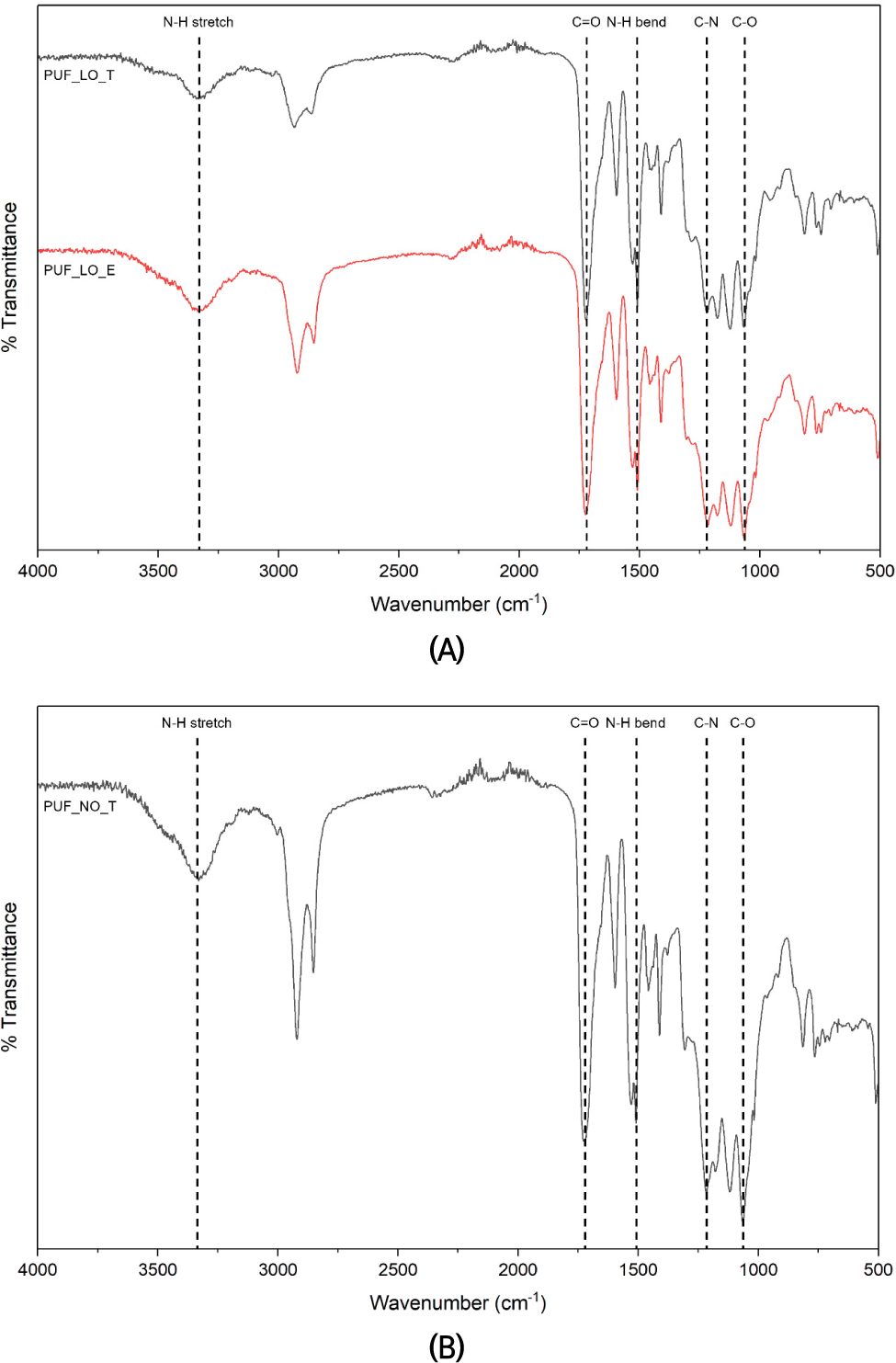
바이오 기반 폴리우레탄 폼의 FTIR 스펙트럼은 Fig. 4에 나타내었다. 제조된 모든 폼에서 3,330–3,341 cm–1 (N-H stretching band), 1,720 cm–1 (C=O stretching band), 1,510–1,528 cm–1 (N-H bending band), 1,217–1,220 cm–1 (C-N band), 그리고 1,064–1,066 cm–1 (C-O band) 흡수 피크가 공통적으로 관찰되었다(Huang et al., 2018; Malewska et al., 2026). 이들 피크는 우레탄 결합(-NHCOO-)을 구성하는 주요 작용기의 진동에 해당하며, 이를 통해 폴리우레탄 구조가 형성되었음을 확인하였다(Tenorio-Alfonso et al., 2017).
fep-30-0-260043-g4
Fig. 4. FTIR spectra of (A) bio-based polyurethane foams prepared from linseed oil-derived polyols obtained via transesterification (PUF_LO_T) and epoxidation (PUF_LO_E), and (B) bio-based polyurethane foam prepared from neem oil-derived polyol obtained via transesterification (PUF_NO_T).
Download Original Figure

바이오 기반 폴리우레탄 폼의 겉보기 밀도는 Table 4에 제시하였다. pOH_LO_E를 사용한 폴리우레탄 폼(PUF_LO_E)의 겉보기 밀도는 43.6±0.4 kg/m3로, pOH_LO_T와 pOH_NO_T를 각각 적용한 PUF_LO_T와 PUF_NO_T의 겉보기 밀도보다 낮았다. 이러한 차이는 폼 제조에 사용된 폴리올의 산가와 관련이 있는 것으로 판단된다. PUF_LO_E에 사용된 pOH_LO_E의 산가는 12.8±1.6 mg KOH/g으로, PUF_LO_T와 PUF_NO_T에 각각 사용된 pOH_LO_T와 pOH_NO_T보다 높았다(Table 2). 폴리올에 존재하는 카복실산 등의 산은 이소시아네이트와 반응하여 이산화탄소를 생성하므로, 물과 이소시아네이트의 발포 반응과 함께 추가적인 기체 생성에 기여할 수 있다(Modesti et al., 1998). 따라서 pOH_LO_E의 높은 산가로 인해 발포 과정에서 이산화탄소 생성량이 증가하였으며, 이에 따라 폼의 팽창이 촉진되어 PUF_LO_E의 겉보기 밀도가 낮아진 것으로 보인다(Thirumal et al., 2008; Kamińska et al., 2022).

Table 4. Apparent density, tensile strength, percentage elongation at break, tear strength, and compressive strength of bio-based polyurethane foams
Sample Apparent density (kg/m3) Tensile strength (kPa) Percentage elongation at break (%) Tear strength (kN/m) Compressive strength (MPa)
PUF_LO_T1) 60.4±2.7a 13.1±1.5c 34.9±10.4a 5.5±0.1a 1.8±0.3b
PUF_LO_E2) 43.6±0.4b 40.3±6.4a 39.9±15.6a 5.5±0.1a 6.0±0.6a
PUF_NO_T3) 56.3±3.1a 29.7±1.3b 22.2±10.3a 4.4±0.1b 0.1±0.1c

PUF_LO_T: Polyurethane foams prepared from transesterified linseed oil-derived polyols.

PUF_LO_E: Polyurethane foams prepared from epoxidized linseed oil-derived polyols.

PUF_NO_T: Polyurethane foams prepared from transesterified neem oil-derived polyols.

Means followed by the same lower-case letter within a column are not significantly different (p>0.05) based on ANOVA followed by Tukey’s multiple range test.

Download Excel Table

본 연구에서 식물유 기반 폴리올을 사용하여 제조한 폴리우레탄 폼의 인장강도, 신장률, 인열강도, 그리고 압축강도를 Table 4에 제시하였다. 일반적으로 폴리올의 수산기가 높을수록 단위 질량당 이소시아네이트와 반응할 수 있는 수산기 당량이 증가하며, 우레탄 결합과 폴리우레탄 네트워크의 형성이 증가할 수 있다(Nadim et al., 2024; Zhang et al., 2025). 이렇게 형성된 네트워크는 고분자 사슬의 운동성을 제한하고 외부 하중에 대한 저항성을 높여 인장강도와 압축강도 향상에 기여할 수 있다(Lim et al., 2008; Rojek & Prociak, 2012; Członka et al., 2020). 그러나 폼의 특성은 수산기가뿐 아니라 폴리올의 분자구조, 이소시아네이트와의 당량비, 겉보기 밀도, 그리고 셀 구조 등 다양한 요인에 의해 달라질 수 있다(Nozaki et al., 2017; Tilly et al., 2019; Nagy et al., 2021; Olszewski et al., 2022). 본 연구에서 제조한 폴리우레탄 폼들은 앞서 언급된 바와 같이 isocyanate index에 차이가 있었는데 이 또한 폼의 특성에 영향을 미쳤을 것으로 판단되었다(Amran et al., 2021).

PUF_LO_E의 인장강도는 40.3±6.4 kPa로, PUF_NO_T와 PUF_ LO_T보다 높았다(Table 4). pOH_LO_E의 수산기가는 128.4±0.6 mg KOH/g으로 pOH_LO_T (54.5±1.7 mg KOH/g)보다 높았으며(Table 2), 이러한 높은 수산기는 우레탄 결합과 폴리우레탄 네트워크 형성을 증가시켜 PUF_LO_E의 높은 인장강도에 기여했을 가능성이 있다. 그러나 PUF_NO_T의 인장강도는 PUF_LO_E보다 낮았다. 님유의 에스테르교환반응에서는 모노글리세리드와 디글리세리드가 형성되는 반면, 아마인유의 에폭시화 반응에서는 지방산 사슬의 이중결합에 수산기가 도입된다(Calvo-Correas et al., 2015; Liao et al., 2021). 따라서 pOH_NO_T와 pOH_LO_E 사이의 분자구조와 수산기의 위치 차이가 이소시아네이트와의 반응과 형성되는 폴리우레탄 네트워크 구조에 영향을 미쳐, PUF_LO_E의 높은 인장강도에 기여했을 가능성이 있다(Nozaki et al., 2017; Prociak et al., 2018).

pOH_LO_T, pOH_LO_E, 그리고 pOH_NO_T를 적용한 세 폴리우레탄 폼의 신장률은 통계적으로 유의한 차이를 보이지 않았다(p>0.05). 폴리우레탄 폼의 신장률은 폴리올의 분자구조, 수산기의 위치, 그리고 이에 따른 폴리우레탄 네트워크 구조와 고분자 사슬의 운동성에 영향을 받는다(Zlatanić et al., 2004; Nozaki et al., 2017; Prociak et al., 2018). 본 연구에서는 폴리올의 종류, 합성 방법, 그리고 배합 조건에 따라 형성된 폴리우레탄의 구조적 특성이 서로 달랐을 수 있었으나, 그 차이는 세 폼의 신장률에 통계적으로 유의한 차이를 유발할 정도로 크지 않았던 것으로 판단되었다.

PUF_LO_T와 PUF_LO_E의 인열강도는 모두 5.5 kN/m로 PUF_ NO_T보다 유의적으로 높았다(p<0.05). 식물유 유래 폴리올의 지방산 사슬 구조와 수산기 위치는 이소시아네이트와의 반응성과 폴리우레탄 네트워크 형성에 영향을 미치며, 이에 따라 형성된 네트워크의 차이는 최종 폼의 인열 저항성에 반영될 수 있다(Zlatanić et al., 2004; Garrison et al., 2014; Zhang et al., 2015). 따라서 PUF_ LO_T와 PUF_LO_E가 PUF_NO_T보다 높은 인열강도를 나타낸 것은 아마인유와 님유 유래 폴리올의 구조적 차이가 최종 폴리우레탄 구조와 인열 저항성에 서로 다르게 반영되었기 때문으로 판단된다. PUF_LO_T와 PUF_LO_E 사이에서는 인열강도에 유의적인 차이가 나타나지 않았다(p>0.05). 두 폴리올은 합성 방법과 수산기가에 차이가 있으나, 동일한 아마인유에서 유래하므로 유사한 지방산 조성과 장쇄 구조를 지닌다. 이러한 공통적인 구조적 특성으로 인해 합성 방법의 차이에도 불구하고 두 폼에서 유사한 인열강도가 보인 것으로 판단되었다(Zhang et al., 2023; Zhou et al., 2024).

PUF_LO_E의 압축강도는 6.0±0.6 MPa로 PUF_LO_T와 PUF_ NO_T보다 높았다(Table 4). 일반적으로 폼의 겉보기 밀도가 증가하면 하중을 지지하는 고분자의 양이 증가하여 압축강도가 높아질 수 있다(Mosiewicki et al., 2009; Strąkowska et al., 2019). 그러나 PUF_ LO_E는 세 폼 중 겉보기 밀도가 가장 낮았음에도 가장 높은 압축강도를 나타냈다. 이는 압축강도가 겉보기 밀도뿐 아니라 폴리우레탄 네트워크와 셀 구조 등 다양한 요인에 의해 영향을 받을 수 있음을 시사한다(Olszewski et al., 2022). PUF_LO_E의 제조에 사용된 pOH_ LO_E는 pOH_LO_T보다 높은 수산기가를 나타냈으며(Table 2), 이러한 차이가 폴리우레탄 사슬 간 연결 구조 형성에 기여하여 압축 하중에 대한 저항성을 높였을 것으로 생각된다(Lim et al., 2008; Członka et al., 2020). PUF_NO_T의 압축강도는 세 폼 중 가장 낮았다. 이는 폴리올의 분자구조와 수산기 위치에 따른 이소시아네이트와의 반응성 차이와 배합 조건의 차이로 인해 폴리우레탄 네트워크 형성 정도가 달라졌기 때문으로 해석된다(Prociak et al., 2018).

제조된 폴리우레탄 폼의 색도는 Table 5에 나타내었다. PUF_ NO_T는 세 폼 중 가장 낮은 L*값(66.2±3.0)과 가장 높은 a*값(7.3±1.8)과 b*값(37.4±0.7)을 나타내 상대적으로 명도가 낮고 적색도와 황색도가 높았다. 물을 발포제로 사용하는 폴리우레탄 폼은 발포 과정에서 발생하는 열에 의해 폼 내부의 온도가 상승하며, 이 과정에서 열분해와 산화가 발생하여 황색 또는 갈색으로 변색될 수 있다(Luda et al., 2004). PUF_NO_T에는 PUF_LO_T와 PUF_LO_E보다 많은 양의 이소시아네이트가 사용되었으며, 이소시아네이트 함량이 증가하면 발포 과정에서 열 생성이 늘어나 폼 내부 온도가 더 높게 상승할 수 있다(Kamińska et al., 2022). 따라서 PUF_NO_T에서는 열분해와 산화에 의한 변색이 상대적으로 크게 나타났을 것으로 생각되었다.

Table 5. Color of bio-based polyurethane foam
Sample Color
L* a* b*
PUF_LO_T1) 77.3±0.6a -2.7±0.1b 13.4±0.5c
PUF_LO_E2) 78.9±1.6a -4.1±0.2b 24.8±0.7b
PUF_NO_T3) 66.2±3.0b 7.3±1.8a 37.4±0.7a

PUF_LO_T: Polyurethane foams prepared from transesterified linseed oil-derived polyols.

PUF_LO_E: Polyurethane foams prepared from epoxidized linseed oil-derived polyols.

PUF_NO_T: Polyurethane foams prepared from transesterified neem oil-derived polyols.

Means followed by the same lower-case letter within a column are not significantly different (p>0.05) based on ANOVA followed by Tukey’s multiple range test.

Download Excel Table

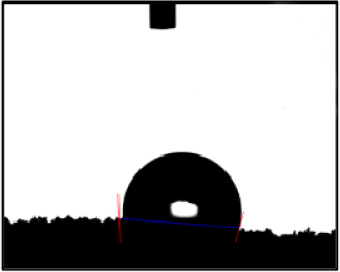
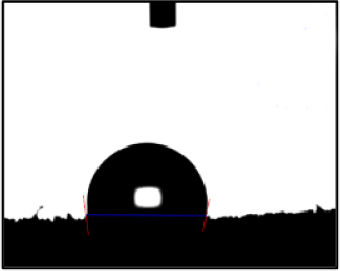
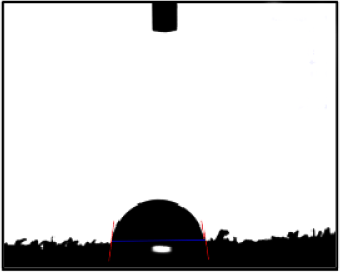
바이오 기반 폴리우레탄 폼의 접촉각은 Table 6에 제시하였다. 일반적으로 접촉각이 90° 이상이면 소수성, 90° 이하이면 친수성 표면으로 해석된다(Wang et al., 2024). PUF_LO_T와 PUF_LO_E의 접촉각은 각각 99.8±0.2°와 100.9±0.1°로 소수성 표면 특성을 보인 반면, PUF_NO_T의 접촉각은 81.9±0.3°로 친수성 표면 특성을 나타냈다. PUF_NO_T의 제조에 사용된 pOH_NO_T는 세 폴리올 중 가장 높은 수산기 함량을 나타냈는데(Table 2), 본 결과에서 보여준 PUF_NO_T의 친수성은 일부 수산기가 이소시아네이트와 완전히 반응하지 못하고 폼 표면에 잔류하며 물 분자와 결합했기 때문으로 보였다(Amran et al., 2021; Thusanaphoom et al., 2026).

Table 6. Water contact angle of bio-based polyurethane foams
Sample Contact angle image Contact angle (°)
PUF_LO_T1) fep-30-0-260043-g5 99.8±0.2b
PUF_LO_E2) fep-30-0-260043-g6 100.9±0.1a
PUF_NO_T3) fep-30-0-260043-g7 81.9±0.3c

PUF_LO_T: Polyurethane foams prepared from transesterified linseed oil-derived polyols.

PUF_LO_E: Polyurethane foams prepared from epoxidized linseed oil-derived polyols.

PUF_NO_T: Polyurethane foams prepared from transesterified neem oil-derived polyols.

Means followed by the same lower-case letter within a column are not significantly different (p>0.05) based on ANOVA followed by Tukey’s multiple range test.

Download Excel Table
바이오 기반 폴리우레탄 폼의 보호 성능 평가

메추리알을 이용한 반복 낙하 시험 결과, PUF_LO_T와 PUF_ NO_T로 포장된 메추리알은 각각 25회 낙하 후 파손된 반면, PUF_ LO_E로 포장된 메추리알은 480회 낙하 후 파손되었다(Table 7). 폼 완충재는 충격 시 변형되면서 충격에너지를 흡수하여 내용물에 전달되는 하중을 감소시키고, 반복적인 충격에도 형상을 유지하거나 회복함으로써 보호 성능을 유지할 수 있다(Xiao et al., 2022; Schäfer et al., 2025). PUF_LO_E가 다른 두 폼보다 높은 보호 성능을 나타낸 것은 폴리올 합성 방법에 따른 수산기 위치의 차이가 폴리우레탄 네트워크 구조와 압축 저항성에 영향을 미쳤기 때문으로 생각된다. PUF_LO_E에 사용된 pOH_LO_E는 에폭시화 반응을 통해 지방산 사슬에 수산기가 형성되는 반면, pOH_LO_T와 pOH_ NO_T는 에스테르교환반응을 통해 글리세롤 골격에 수산기가 형성된다(Arniza et al., 2015). PUF_LO_E에서는 지방산 사슬에 형성된 수산기가 이소시아네이트와 반응하여 폴리우레탄 네트워크 형성에 참여함으로써 고분자 사슬의 운동성이 제한되어 압축 하중에 대한 저항성이 높아졌을 것으로 판단된다(Zlatanić et al., 2004; Kurańska et al., 2025). 높아진 압축 저항성은 반복적인 충격에 따른 폼의 과도한 변형을 억제하고, 메추리알을 둘러싼 포장 형태를 유지하는 데 기여했을 것이다.

Table 7. Number of drops until shell breakage of quail eggs packaged in bio-based polyurethane foams
Sample PUF_LO_T1) PUF_LO_E2) PUF_NO_T3)
Number of drops 25 480 25

PUF_LO_T: Polyurethane foams prepared from transesterified linseed oil-derived polyols.

PUF_LO_E: Polyurethane foams prepared from epoxidized linseed oil-derived polyols.

PUF_NO_T: Polyurethane foams prepared from transesterified neem oil-derived polyols.

Download Excel Table

요 약

본 연구에서는 비식용 식물유로부터 바이오 폴리올을 합성하고, 이를 이용하여 제조한 폴리우레탄 폼의 특성과 식품 보호용 포장재로서의 적용 가능성을 평가하였다. 산가, 요오드가, 그리고 색도 분석을 통해 원료로 사용된 식물유와 합성된 바이오 폴리올의 특성을 확인하였으며, 수산기가와 FTIR 분석 결과를 통해 아마인유와 님유에 수산기가 도입되어 폴리우레탄 폼 제조에 적합한 바이오 폴리올로 전환되었음을 확인하였다. 또한 제조된 바이오 기반 폴리우레탄 폼의 FTIR 분석 결과, 우레탄 결합과 관련된 피크가 관찰되어 폴리우레탄 구조가 형성되었음을 알 수 있었다. PUF_LO_E는 세 폼 중 가장 낮은 겉보기 밀도와 가장 높은 인장강도와 압축강도를 나타냈다. 세 폼의 신장률에는 유의적인 차이가 없었으며(p>0.05), PUF_LO_T와 PUF_LO_E의 인열강도는 PUF_NO_T보다 높았으나 두 아마인유 기반 폼 간에는 유의적인 차이가 없었다(p>0.05). 색도에서는 PUF_NO_T의 명도가 가장 낮고 적색도와 황색도가 가장 높았으며, 물 접촉각은 PUF_LO_T와 PUF_LO_E에서 PUF_NO_T보다 높게 나타났다. 메추리알을 이용한 반복 낙하 시험에서 PUF_LO_T와 PUF_NO_T로 포장한 메추리알은 25회 낙하 후 파손된 반면, PUF_LO_E로 포장한 메추리알은 480회 낙하 후 파손되어 가장 높은 보호 성능을 나타내었다. 본 연구의 결과는 비식용 식물유 기반 바이오 폴리올이 기존 석유계 원료를 일부 대체하는 바이오 기반 폴리우레탄 폼의 소재로 사용될 수 있으며, 제조된 폼이 식품 보호용 포장재로 적용될 가능성이 있음을 확인하였다.

Conflict of interests

No potential conflict of interest relevant to this article was reported.

Acknowledgements

This work was supported by Korea Institute of Planning and Evaluation for Technology in Food, Agriculture and Forestry (IPET) through High Value-added Food Technology Development Program, funded by Ministry of Agriculture, Food and Rural Affairs (MAFRA) (RS-2025-02232975).

Data availability

Upon reasonable request, the datasets of this study can be available from the corresponding author.

Authorship contribution statement

Conceptualization: You YS, Kim N, Kim SH, Min SC.

Data curation: Ha YE, Myung GE.

Formal analysis: Ha YE, Myung GE.

Methodology: Ha YE, Myung GE, Kim N, Kim SH, Min SC.

Software: Min SC.

Validation: Ha YE, Myung GE.

Investigation: Ha YE, Myung GE, Min SC.

Writing - original draft: Ha YE.

Writing - review & editing: Ha YE, Myung GE, You YS, Kim N, Kim SH, Min SC.

Ethics approval

Not applicable.

References

1.

Abolins A, Pomilovskis R, Vanags E, Mierina I, Michalowski S, Fridrihsone A, Kirpluks M. 2021. Impact of different epoxidation approaches of tall oil fatty acids on rigid polyurethane foam thermal insulation. Materials. 14: 894.

2.

Agrawal A, Kaur R, Walia RS. 2017. PU foam derived from renewable sources: perspective on properties enhancement: an overview. Eur. Polym. J. 95: 255-274.

3.

Albayrak O, Ipekoglu M, Uctu O, Batibay GS, Calik A, Pilipović A. 2026. Structure–property relationships in polyester-based polyurethane foams with varying isocyanate index for footwear midsole applications. Polymers. 18: 1896.

4.

Amran UA, Salleh KM, Zakaria S, Roslan R, Chia CH, Jaafar SNS, Sajab MS, Mostapha M. 2021. Production of rigid polyurethane foams using polyol from liquefied oil palm biomass: variation of isocyanate indexes. Polymers 13: 3072.

5.

Arniza MZ, Hoong SS, Idris Z, Yeong SK, Hassan HA, Din AK, Choo YM. 2015. Synthesis of transesterified palm olein-based polyol and rigid polyurethanes from this polyol. J. Am. Oil Chem. Soc. 92: 243-255.

6.

ASTM. 2021. Standard Test Method for Determination of the Iodine Value of Fats and Oils (ASTM D5554-15 (2021)). ASTM International, West Conshohocken, PA, USA.

7.

ASTM. 2023. Standard test methods for testing polyurethane raw materials: determination of hydroxyl numbers of polyols (ASTM D4274-23). ASTM International, West Conshohocken, PA, USA.

8.

Atabani AE, Silitonga AS, Ong HC, Mahlia TMI, Masjuki HH, Badruddin IA, Fayaz H. 2013. Non-edible vegetable oils: a critical evaluation of oil extraction, fatty acid compositions, biodiesel production, characteristics, engine performance and emissions production. Renew. Sustain. Energy Rev. 18: 211-245.

9.

Borowicz M, Paciorek-Sadowska J, Isbrandt M. 2025. “From seed to product” – synthesis of high-value bio-polyol raw materials from white mustard seed processing and assessment of the influence of the degree of oxidation on the properties of the obtained products. Ind. Crop. Prod. 227: 120813.

10.

Briede S, Biemans T, Platnieks O, Gaidukovs S. 2025. Tailored UV-curable acrylated linseed oil-based alkyds: optimizing crosslinking and coating performance through functionalization and reactive diluent design. Polymer. 323: 128227.

11.

Calvo-Correas T, Mosiewicki MA, Corcuera M, Eceiza A, Aranguren MI. 2015. Linseed oil-based polyurethane rigid foams: synthesis and characterization. J. Renew. Mater. 3: 3-13.

12.

Campos EV, de Oliveira JL, Pascoli M, de Lima R, Fraceto LF. 2016. Neem oil and crop protection: from now to the future. Front. Plant Sci. 7: 1494.

13.

Chang CW, Chang JP, Lu KT. 2018. Synthesis of linseed oil-based waterborne urethane oil wood coatings. Polymers. 10: 1235.

14.

Członka S, Bertino MF, Kośny J, Strąkowska A, Masłowski M, Strzelec K. 2018. Linseed oil as a natural modifier of rigid polyurethane foams. Ind. Crop. Prod. 115: 40-51.

15.

Członka S, Strąkowska A, Kairytė A. 2020. Application of walnut shells-derived biopolyol in the synthesis of rigid polyurethane foams. Materials. 13: 2687.

16.

Delavarde A, Savin G, Derkenne P, Boursier M, Morales- Cerrada R, Nottelet B, Pinaud J, Caillol S. 2024. Sustainable polyurethanes: toward new cutting-edge opportunities. Prog. Polym. Sci. 151: 101805.

17.

Desroches M, Escouvois M, Auvergne R, Caillol S, Boutevin B. 2012. From vegetable oils to polyurethanes: synthetic routes to polyols and main industrial products. Polym. Rev. 52: 38-79.

18.

Eling B, Tomović Ž, Schädler V. 2020. Current and future trends in polyurethanes: an industrial perspective. Macromol. Chem. Phys. 221: 2000114.

19.

Fan X, He W, Li K, Huang J. 2025. Zein-castor oil-based soft polyurethane foam with enhanced ethylene adsorption, cushioning, and thermal insulation for fig packaging. Food Packag. Shelf Life. 52: 101653.

20.

Fan X, Wang H, Kong L, Huang J. 2024. Advanced ethylene- absorbing and cushioning depending on the 3D porous- structured fruit packaging: toward polyurethane foam manipulation using zein and soybean oil polyol substrates. Food Res. Int. 186: 114340.

21.

Favero D, Marcon VRR, Barcellos T, Gómez CM, Sanchis MJ, Carsí M, Figueroa CA, Bianchi O. 2019. Renewable polyol obtained by microwave-assisted alcoholysis of epoxidized soybean oil: preparation, thermal properties and relaxation process. J. Mol. Liq. 285: 136-145.

22.

Felizardo P, Machado J, Vergueiro D, Correia MJN, Gomes JP, Bordado JM. 2011. Study on the glycerolysis reaction of high free fatty acid oils for use as biodiesel feedstock. Fuel Process. Technol. 92: 1225-1229.

23.

Gama NV, Ferreira A, Barros-Timmons A. 2018. Polyurethane foams: past, present, and future. Materials. 11: 1841.

24.

Garrison TF, Kessler MR, Larock RC. 2014. Effects of unsaturation and different ring-opening methods on the properties of vegetable oil-based polyurethane coatings. Polymer. 55: 1004-1011.

25.

Grignard B, Bourguignon M, Monie F, Vidil T, Cramail H, Perli G, Sardon H, Raquez JM, Caillol S, Detrembleur C. 2026. Non-isocyanate polyurethane foams: where we stand and what comes next? Chem. Soc. Rev. 55: 4960-5004.

26.

Guesmi R, Benbettaieb N, Ben Romdhane MR, Barhoumi-Slimi T, Assifaoui A. 2022. In situ polymerization of linseed oil-based composite film: enhancement of mechanical and water barrier properties by the incorporation of cinnamaldehyde and organoclay. Molecules. 27: 8089.

27.

Hamadou B, Djomdi, Falama RZ, Delattre C, Pierre G, Dubessay P, Michaud P. 2020. Influence of physicochemical characteristics of neem seeds (Azadirachta indica A. Juss) on biodiesel production. Biomolecules. 10: 616.

28.

Huang X, Cornelis F, Xie J, Wu Q, Boldor D, Qi J. 2018. High bio-content polyurethane (PU) foam made from bio-polyol and cellulose nanocrystals (CNCs) via microwave liquefaction. Mater. Des. 138: 11-20.

29.

Janković MR, Govedarica OM, Sinadinović-Fišer SV. 2020. The epoxidation of linseed oil with in situ formed peracetic acid: a model with included influence of the oil fatty acid composition. Ind. Crop. Prod. 143: 111881.

30.

Jayavani S, Sunanda S, Varghese TO, Nayak SK. 2017. Synthesis and characterizations of sustainable polyester polyols from non-edible vegetable oils: thermal and structural evaluation. J. Clean. Prod. 162: 795-805.

31.

Ju YH, Sari NNF, Go AW, Wang MJ, Agapay RC, Ayucitra A. 2020. Preparation of epoxidized fatty acid ethyl ester from tung oil as a bio-lubricant base-stock. Waste Biomass Valorization. 11: 4145-4155.

32.

Kaikade DS, Sabnis AS. 2023. Polyurethane foams from vegetable oil-based polyols: a review. Polym. Bull. 80: 2239-2261.

33.

Kamińska K, Barczewski M, Kurańska M, Malewska E, Polaczek K, Prociak A. 2022. The effect of a chemical foaming agent and the isocyanate index on the properties of open-cell polyurethane foams. Materials. 15: 6087.

34.

Khalid T, Naheed S, Fazal-ur-Rehman, Salman M. 2025. Advancing sustainable adhesive: potential use of recycled polyethylene terephthalate (PET) polyols for the synthesis of polyurethane hot melts adhesive. J. Saudi Chem. Soc. 29: 18.

35.

Kurańska M, Malewska E, Beneš H, Nevoralová M, Zemła M, Michałowski S, Śmietana K, Prociak A. 2025. Biopolyols obtained from rapeseed oil as a replacement of petrochemical components in the production of ecological thermal insulation materials. Clean Technol. Environ. Policy 27: 4325-4336.

36.

Lee J, Kim JH. 2023. Performance evaluations of flexible polyurethane foams manufactured with castor oil-based bio- polyol. Polym. Test. 124: 108069.

37.

Li H, Mahmood N, Ma Z, Zhu M, Wang J, Zheng J, Yuan Z, Wei Q, Xu CC. 2017. Preparation and characterization of bio-polyol and bio-based flexible polyurethane foams from fast pyrolysis of wheat straw. Ind. Crop. Prod. 103: 64-72.

38.

Li J, Kuang Y, Bi Y, Sun S, Peng D. 2022. Preparation of biopolyols by pyrrolidone ionic liquid-catalyzed ring-opening of epoxidized soybean oils. Ind. Crop. Prod. 185: 115112.

39.

Liao YH, Su YL, Chen YC. 2021. The influence of neem oil and its glyceride on the structure and characterization of castor oil-based polyurethane foam. Polymers. 13: 2020.

40.

Lim H, Kim SH, Kim BK. 2008. Effects of the hydroxyl value of polyol in rigid polyurethane foams. Polym. Adv. Technol. 19: 1729-1734.

41.

Luda MP, Bracco P, Costa L, Levchik SV. 2004. Discolouration in fire retardant flexible polyurethane foams. Part I. Characterisation. Polym. Degrad. Stab. 83: 215-220.

42.

Malewska E, Antonkiewicz J, Kurańska M, Rybarczyk P, Rogala A. 2026. Phytoremediation-derived sunflower oil for bio-based polyurethane foams. Ind. Crop. Prod. 239: 122439.

43.

Malewska E, Kurańska M, Tenczyńska M, Prociak A. 2023. Application of modified seed oils of selected fruits in the synthesis of polyurethane thermal insulating materials. Materials. 17: 158.

44.

Ministry of Food and Drug Safety (MFDS). 2025. Acid value test method. Available from: https://various.foodsafetykorea. go.kr/fsd/#/ext/Document/FC. Accessed Nov. 5, 2025.

45.

Mo Y, Huang X, Hu C. 2024. Recent advances in the preparation and application of bio-based polyurethanes. Polymers. 16: 2155.

46.

Modesti M, Baldoin N, Simioni F. 1998. Formic acid as a co-blowing agent in rigid polyurethane foams. Eur. Polym. J. 34: 1233-1241.

47.

Mosiewicki MA, Dell'Arciprete GA, Aranguren MI, Marcovich NE. 2009. Polyurethane foams obtained from castor oil-based polyol and filled with wood flour. J. Compos. Mater. 43: 3057-3072.

48.

Nadim E, Paraskar P, Hesabi M, Yahyaei H, Murphy EJ, Major I. 2024. Sustainable polyurethane coatings derived from alkyds of Camelina oil monoglycerides. J. Appl. Polym. Sci. 141: e56079.

49.

Nagy L, Vadkerti B, Lakatos C, Fehér PP, Zsuga M, Kéki S. 2021. Kinetically equivalent functionality and reactivity of commonly used biocompatible polyurethane crosslinking agents. Int. J. Mol. Sci. 22: 4059.

50.

Nia ST, Nikje MMA. 2025. Novel bio-polyol synthesis based on date seed oil for low-density rigid polyurethane-polyisocyanurate foams. Ind. Crop. Prod. 223: 120152.

51.

Nozaki S, Hirai T, Higaki Y, Yoshinaga K, Kojio K, Takahara A. 2017. Effect of chain architecture of polyol with secondary hydroxyl group on aggregation structure and mechanical properties of polyurethane elastomer. Polymer. 116: 423-428.

52.

Olszewski A, Kosmela P, Piasecki A, Żukowska W, Szczepański M, Wojtasz P, Barczewski M, Barczewski R, Hejna A. 2022. Comprehensive investigation of stoichiometry–structure–performance relationships in flexible polyurethane foams. Polymers. 14: 3813.

53.

Oyewole T, Sarker NC, Dhaliwal G, Biggane E, Monono E. 2025. Investigating the effect of refining parameters on acetic acid removal and the quality of crude epoxidized soybean oil. J. Am. Oil Chem. Soc. 102: 47-59.

54.

Patil CK, Jung DW, Jirimali HD, Baik JH, Gite VV, Hong SC. 2021. Nonedible vegetable oil-based polyols in anticorrosive and antimicrobial polyurethane coatings. Polymers. 13: 3149.

55.

Prociak A, Kurańska M, Cabulis U, Ryszkowska J, Leszczyńska M, Uram K, Kirpluks M. 2018. Effect of bio-polyols with different chemical structures on foaming of polyurethane systems and foam properties. Ind. Crop. Prod. 120: 262-270.

56.

Ramírez LM, Cadavid JG, Orjuela A, Gutierrez MF, Bohorquez WF. 2022. Epoxidation of used cooking oils: kinetic modeling and reaction optimization. Chem. Eng. Process. Process Intensif. 176: 108963.

57.

Rojek P, Prociak A. 2012. Effect of different rapeseed-oil-based polyols on mechanical properties of flexible polyurethane foams. J. Appl. Polym. Sci. 125: 2936-2945.

58.

Rossi D, Anguillesi I, Cappello M, Dell’Anna MM, Seggiani M. 2026. Novel synthesis of flexible polyurethane foams with high bio-based content derived from waste cooking oil. Sci. Rep. 16: 554.

59.

Santos M, Mariz M, Tiago I, Alarico S, Ferreira P. 2025. Bio-based polyurethane foams: feedstocks, synthesis, and applications. Biomolecules. 15: 680.

60.

Schäfer K, Nestler D, Kroll L. 2025. Impact compressive properties of polyurethane foams with 3D continuous fibre reinforcement. Proc. Inst. Mech. Eng. Part L J. Mater. Des. Appl. 239: 706-719.

61.

Strąkowska A, Członka S, Strzelec K. 2019. POSS compounds as modifiers for rigid polyurethane foams (Composites). Polymers. 11: 1092.

62.

Tenorio-Alfonso A, Sánchez MC, Franco JM. 2017. Preparation, characterization and mechanical properties of bio-based polyurethane adhesives from isocyanate-functionalized cellulose acetate and castor oil for bonding wood. Polymers. 9: 132.

63.

Thirumal M, Khastgir D, Singha NK, Manjunath BS, Naik YP. 2008. Effect of foam density on the properties of water blown rigid polyurethane foam. J. Appl. Polym. Sci. 108: 1810-1817.

64.

Thusanaphoom P, Yuennan J, Chailad W, Songsri S, Laemlaksakul V, Rodon-Fores J, Wongnongwa Y, Sukhawipat N. 2026. Upcycling recycled PET into high-performance polyurethane coating and engineering materials: effect of NCO index on mechanical, stability, and surface properties. ACS Polym. Au. 6: 1468-1487.

65.

Tilly JC, Pervaje AK, Inglefield DL, Santiso EE, Spontak RJ, Khan SA. 2019. Spectroscopic and rheological cross-analysis of polyester polyol cure behavior: role of polyester secondary hydroxyl content. ACS Omega. 4: 932-939.

66.

Tinti A, Tarzia A, Passaro A, Angiuli R. 2014. Thermographic analysis of polyurethane foams integrated with phase change materials designed for dynamic thermal insulation in refrigerated transport. Appl. Therm. Eng. 70: 201-210.

67.

Varghese TP, Gopalakrishnan J. 2026. Effect of peroxide concentration on the epoxidation of vegetable seed oil. Mater. Today Proc. 125: 137-140.

68.

Wang C, Xu Z, Xia Y, Zhang C, Fang H, Sun K. 2024. Water transport mechanism and performance evaluation in polyurethane materials: a state-of-the-art review. Polym. Test. 138: 108554.

69.

Wu YC, Chen YC. 2025. Castor oil and its glyceride-based polyurethane flexible and rigid foam with vanillin for antibacterial material. Ind. Crop. Prod. 232: 121275.

70.

Xiao Y, Yin J, Zhang X, An X, Xiong Y, Sun Y. 2022. Mechanical performance and cushioning energy absorption characteristics of rigid polyurethane foam at low and high strain rates. Polym. Test. 109: 107531.

71.

Zhang C, Madbouly SA, Kessler MR. 2015. Biobased polyurethanes prepared from different vegetable oils. ACS Appl. Mater. Interfaces. 7: 1226-1233.

72.

Zhang J, Wu S, Wang F, Liu G, Tan Y, Zhang C, Shan H, Ling G, Liu D, Guo Y, Chen Y. 2023. Luffa seed oil-modified polyurethane viscoelastic foam with good tear resistance. Ind. Crop. Prod. 193: 116156.

73.

Zhang Z, Ni N, Xu Y. 2025. Effects of different polyols with functions on the properties of polyester polyol-based polyurethane coatings. Coatings. 15: 61.

74.

Zhou J, Wu S, Zhang C, Shan H, Ling G, Xu R, Zhang J, Hong L, Guo Y, Chen Y. 2024. High-performance bio-based foam from agricultural waste luffa seed oil polyols. Mater. Today Commun. 41: 110438.

75.

Zlatanić A, Lava C, Zhang W, Petrović ZS. 2004. Effect of structure on properties of polyols and polyurethanes based on different vegetable oils. J. Polym. Sci. B Polym. Phys. 42: 809-819.