

Introduction
Carotenoids are natural lipid-soluble pigments which are responsible for the yellow, orange, and red colors of various vegetables and fruits (Amorim-Carrilho et al., 2014; Saini et al., 2015). Hydrocarbon carotenoids such as α-carotene, β-carotene and lycopene are collectively referred to as carotenes, whereas oxygen-containing carotenoids such as lutein and zeaxanthin are termed xanthophylls (Rodriguez-Amaya, 2001; Amorim-Carrilho et al., 2014). Yellow-orange vegetables and fruits are major sources of α-carotene and β-carotene, orange fruits are rich in α-cryptoxanthin, dark green vegetables and egg yolk provide lutein and zeaxanthin, and tomatoes are representative sources of lycopene (Amorim-Carrilho et al., 2014).
Carotenoids also function as antioxidants, thereby contributing to the stability of foods (Rodriguez-Amaya, 2010). In plants, carotenoids serve as accessory pigments in photosynthesis, photoprotective compounds, regulators of plant growth and development, precursors of the hormones abscisic acid and strigolactones, and attractants for pollinating insects and seed-dispersing animals (Rivera & Canela-Garayoa, 2012). In humans, carotenoids have been associated with various health-promoting effects, including antioxidant activity, immune enhancement, visual function, and reduced risk of degenerative diseases such as cancer, cardiovascular diseases, cataracts, and age-related macular degeneration (Rodriguez-Amaya, 2010; Rivera & Canela-Garayoa, 2012; Kurek et al., 2025). In addition, some carotenoids, including β-carotene and β-cryptoxanthin, exhibit provitamin A activity and thus play important roles in human health (Mercadante et al., 2017). Because of these beneficial and essential roles, the carotenoid content of foods has been widely investigated (Hwang et al., 2025; Lee et al., 2025a). As consumer awareness of the importance of micronutrients continues to increase, expanding the available information on micronutrients is essential for developing evidence-based dietary recommendations (Lee et al., 2022).
In nature, carotenoids exist primarily in the more stable all-trans isomeric form, although cis isomers are also present (Rodriguez-Amaya, 2001). The carotenoid composition of plant foods is further diversified by the presence of minor biosynthetic precursors and derivatives of major carotenoids (Rodriguez-Amaya, 2001). Because of their extended conjugated double bond systems in their structure, carotenoids are highly sensitive to light, heat and oxygen and may therefore undergo oxidation or isomerization during food preparation and storage (Giuffrida et al., 2020). Although carotenoids are relatively stable in the matrix, they can become highly susceptible to degradation when extracted into solution, particularly under exposure to light, heat, acid, or oxygen (Amorim-Carrilho et al., 2014). The analysis of carotenoids requires careful attention and presents considerable challenges because of the large number of carotenoids (Rodriguez-Amaya, 2010), and their instability upon exposure to light, oxygen, and heat.
Previous reviews have addressed various aspects of carotenoid analysis, including general analytical methods (Amorim-Carrilho et al., 2014), carotenoid ester analysis (Mercadante et al., 2017), extraction methods (Saini & Keum, 2018), and recent advances in analytical technologies (Kurek et al., 2025). In contrast, this review aims to compare HPLC-based methods for the quantification of major carotenoids in foods, with particular emphasis on sample preparation, extraction and saponification conditions, column selection, mobile-phase composition, detector settings, and method-validation parameters. It also discusses the applicability of these analytical methods to different food matrices and considers future directions for method standardization.
Food carotenoids are generally C40 tetraterpenoids and are biosynthetically derived from phytoene, an early C40 intermediate in the carotenoid biosynthetic pathway (Rodriguez-Amaya, 2001; Saini & Keum, 2018). Based on their chemical structures, carotenoids are commonly classified into two major groups: carotenes and xanthophylls. Carotenes are hydrocarbon carotenoids composed only of carbon and hydrogen atoms (Rodriguez-Amaya, 2001), whereas xanthophylls are oxygenated derivatives of hydrocarbons that contain functional groups such as hydroxyl, epoxy, or keto groups (Saini & Keum, 2018). Carotenes are relatively nonpolar, whereas xanthophylls possess oxygen-containing functional groups and are therefore more polar (Ahmed et al., 2014; Albreht & Križman, 2026). These structural and polarity differences influence solvent selection, chromatographic retention, and elution order during HPLC analysis. In particular, the polarity of carotenoids and the characteristics of the food matrix should be considered when selecting an extraction solvent. In general, nonpolar solvents such as hexane are suitable for the extraction of carotenes and esterified carotenoids, whereas more polar solvents such as ethanol and acetone are more appropriate for xanthophylls (Amorim-Carrilho et al., 2014).
The extended conjugated double-bond system of carotenoids results in strong absorption in the visible region, which enables their detection by UV-Vis or PDA/DAD detectors, generally at wavelengths between 400 and 500 nm (Breithaupt & Schwack, 2000; Inbaraj et al., 2008; Rodriguez-Amaya et al., 2023). In general, an increase in the number of conjugated double bonds shifts the maximum absorption wavelength (λmax) to longer wavelength (Rodriguez-Amaya, 2001). This bathochromic shift is associated with visible color changes from yellow to orange and red. For example, crocin, an acyclic carotenoid derivative with nine conjugated double bonds, appears yellow, whereas bixin, which contains eleven conjugated double bonds, exhibits an orange-red color (Rodriguez-Amaya et al., 2023).
In nature, carotenoids are predominantly present in the more stable all-trans configuration, although small amounts of cis isomers may also be present (Rodriguez-Amaya, 2001). Because cis isomers can differ from their all-trans counterparts in biological activity, such as reduced provitamin A activity, the separation and quantification of cis isomers have become important in carotenoid analysis (Rodriguez-Amaya, 2001; Schieber & Carle, 2005). For example, the quantification of cis- and trans-β-carotene is important because these isomers may exhibit different physiological properties (Akhtar & Bryan, 2008). The occurrence of geometric isomers, together with the susceptibility of carotenoids to oxidation and isomerization, requires careful control of sample extraction, saponification, and chromatographic separation conditions. Upon exposure to light, heat, or acids, carotenoids may undergo E/Z isomerization, which can cause a slight shift in the absorption spectrum toward shorter wavelengths and, consequently, a lightening of color (Giuffrida et al., 2020; Rodriguez-Amaya et al., 2023).
Sample pretreatment is an important step in HPLC-based carotenoid analysis because insufficient homogenization or inappropriate storage conditions can affect extraction efficiency and analyte stability. In several studies, food samples were freeze-dried, ground into a fine powder, and stored under dark and low-temperature conditions before extraction (Saha et al., 2015; Heffernan et al., 2016; Wald et al., 2018; Jung et al., 2025). However, freeze-drying is not always necessary and may be selected depending on the type of food matrix and the purpose of analysis. For example, Akhtar & Bryan (2008) prepared pureed foods and juices using only homogenization, without freeze-drying. Similarly, Larsen & Christensen (2005) analyzed fresh or frozen vegetable samples after homogenization, without a freeze-drying step. These studies indicate that drying and grinding can improve sample homogeneity and storage stability, whereas direct homogenization may be sufficient for liquid, semi-solid, fresh, or frozen food matrices.
Following sample pretreatment, the selection of extraction solvent and extraction conditions is a key factor affecting carotenoid recovery and quantification accuracy. Representative extraction solvents used for carotenoid analysis in different food matrices are summarized in Table 1. Nonpolar solvents, such as hexane and petroleum ether, are commonly used for the extraction of carotenes, whereas relatively polar solvents, such as acetone, ethanol, and methanol, are more suitable for xanthophylls (Amorim-Carrilho et al., 2014; Wald et al., 2018). A similar polarity-based principle is also observed in chromatographic fractionation. For example, Kimura & Rodriguez-Amaya (2002) used different eluting solvent systems to separate carotenoids from lettuce extract, indicating that solvent polarity should be adjusted according to the polarity of the target carotenoids. Relatively polar xanthophylls such as neoxanthin and lutein were eluted using petroleum ether/acetone-based solvent systems, whereas nonpolar carotenes, such as β-carotene, were eluted using less polar petroleum ether/ethyl ether-based solvent systems (Kimura & Rodriguez-Amaya, 2002). However, because multiple carotenoids with different polarities are often present within a single food matrix, the use of separate solvents for each individual carotenoid is impractical. Therefore, many studies have attempted to optimize solvent systems that can simultaneously extract carotenoids with different polarities while minimizing degradation and matrix interference. Amorim-Carrilho et al. (2014) reported that hexane was the most commonly used extraction solvent in previous carotenoid studies, followed by acetone, methanol, and tetrahydrofuran. In specific food matrices, different solvent systems have been selected according to sample characteristics and target carotenoids. For example, Larsen & Christensen (2005) extracted carotenoids from fresh and frozen vegetable samples using cold 100% acetone, whereas Akhtar & Bryan (2008) applied a chloroform-based extraction method to pureed baby foods and juices after acid and antioxidant pretreatment. In other studies, ethanol containing 0.1% (w/v) ascorbic acid was used as an extraction solvent and partitioned with toluene/n-hexane (1:1, v/v) (Hwang et al., 2025; Jung et al., 2025). Inbaraj et al. (2008) used a mixed solvent system of n-hexane/ ethanol/acetone/toluene (10:6:7:7, v/v/v/v) to extract carotenoids from dried Lycium barbarum fruits. Similarly, Hsu et al. (2024) used an n-hexane/ethanol/acetone mixture (1:1:1, v/v/v) to extract carotenoids from goji berry samples prior to saponification, further illustrating the use of mixed solvent systems for matrices rich in carotenoid esters. In addition, Saha et al. (2015) reported that an ethanol/hexane/acetone mixture (2:3:1, v/v/v) provided the highest extraction efficiency among the tested solvent systems for lutein and β-carotene from orange carrot samples using accelerated solvent extraction. These studies indicate that solvent selection should be optimized according to both carotenoid polarity and matrix characteristics rather than relying on a single universal extraction solvent.
| Food matrix | Target analyte | Extraction solvent | Saponification | Reference |
|---|---|---|---|---|
| Vegetables | Carotenoids and carotenoid isomers | Cold acetone | Ambersep 900 OH | Larsen & Christensen, 2005 |
| Fruits and vegetables | Ten carotenoids, including carotenoid isomers | Ethanol with 0.1% (w/v) ascorbic acid; partitioned twice with toluene/n-hexane (1:1, v/v) | 80% KOH | Jung et al., 2025 |
| Vegetables, cereals and mushrooms | Seven carotenoids, including carotenoid isomers | Ethanol with 0.1% (w/v) ascorbic acid; partitioned twice with toluene/n-hexane (1:1, v/v) | 80% KOH | Hwang et al., 2025 |
| Pureed foods and juices | Carotenoids, carotenoid isomers, and retinoids | BHT in ethanol (30 mg/mL) and 0.1 N HCl; partitioned twice with chloroform (HCl was not added to juice samples) | NA | Akhtar & Bryan, 2008 |
| Orange carrot | β-carotene and lutein | ASE; ethanol: hexane: acetone (2:3:1, v/v/v), 60°C, 15 min, 3 cycles (optimized) | NA | Saha et al., 2015 |
| Goji berry | Carotenoids, carotenoid isomers, and carotenoid esters | n-hexane/ethanol/acetone (1:1:1, v/v/v), followed by 10% anhydrous sodium sulfate treatment and repeated hexane extraction | Both conditions; 40% KOH-MeOH | Hsu et al., 2024 |
| Goji berry | Carotenoids, carotenoid isomers, and carotenoid esters | n-hexane/ethanol/acetone/toluene (10:6:7:7, v/v/v/v), followed by 10% anhydrous sodium sulfate treatment and repeated hexane extraction | Both conditions; 40% KOH-MeOH | Inbaraj et al., 2008 |
| Apricot, pumpkin, and their products | Carotenoids, carotenoid isomers, and carotenoid esters | Plant samples and purees: Acetone/hexane (1:1, v/v) with 0.05% (w/v) BHT and 0.05% (w/v) BHA Jams: methanol with 0.1% pyrogallol; partitioned twice with hexane | NA | Kurz et al., 2008 |
| Sea buckthorn berries and leaves | Carotenoids, carotenoid isomers, and carotenoid esters | Methanol: ethyl acetate: petroleum ether (1:1:1, v/v/v) | NA | Pop et al., 2014 |
| Chili peppers and products | 5 carotenoids | Acetone/anhydrous ether (1:1, v/v) (optimized) | 20% KOH-MeOH (optimized) | Xu et al., 2023 |
| Mango and citrus | Carotenoids, carotenoid isomers, and carotenoid esters | Ethyl acetate, followed by methanol; partitioned with diethyl ether/petroleum ether (1:1) and 10% (w/v) NaCl solution | Both conditions; 10% KOH-MeOH | Petry & Mercadante, 2016 |
| Murici fruits | Carotenoids, carotenoid isomers, and carotenoid esters | Acetone; partitioned with petroleum ether/ethyl ether (1:2, v/v) | NA | Rodrigues et al., 2016 |
| Crackers, seasoning powder, and processed seafood | Zeaxanthin, citranaxanthin | Water-saturated 1-butanol (optimized) | NA | Lee et al., 2025b |
The extraction procedure is often followed by a saponification step to remove interfering components, such as lipids and chlorophylls (Larsen & Christensen, 2005; Inbaraj et al., 2008), and to hydrolyze carotenoid esters into their free forms (Lietz & Henry, 1997). However, saponification may also lead to carotenoid losses, degradation, or isomerization, depending on the reaction conditions (Lietz & Henry, 1997; Larsen & Christensen, 2005). Therefore, the necessity of saponification should be determined according to the food matrix, the target carotenoids, and whether free or esterified forms are intended to be quantified.
For example, Larsen & Christensen (2005) evaluated carotenoid contents in green vegetable extracts before and after saponification using Ambersep 900 OH, a strongly basic anion-exchange resin, and reported recoveries close to 100% for most carotenoids, although some compounds, such as neoxanthin and neolutein B, showed different recoveries. In Korean agricultural samples, carotenoid extracts were saponified with potassium hydroxide after ethanol extraction containing ascorbic acid (Hwang et al., 2025; Jung et al., 2025). These studies suggest that saponification can be useful for simplifying carotenoid profiles and quantifying free carotenoids in certain food matrices.
The effect of saponification conditions was further demonstrated by Inbaraj et al. (2008), who compared unsaponified and saponified extracts of Lycium barbarum fruits using HPLC-DAD-APCI-MS. In the unsaponified extract, two free carotenoids and seven carotenoid esters were identified, with zeaxanthin dipalmitate being the predominant compound. In contrast, after saponification, carotenoid esters were hydrolyzed and free carotenoids, particularly all-trans-zeaxanthin, became the major components. The authors also showed that simultaneous extraction and saponification were not suitable for this matrix because carotenoid esters remained after 12 h of treatment. When extraction was followed by saponification, a 6 h reaction was selected as the most appropriate condition, whereas prolonged saponification for 8 h reduced carotenoid yield, probably due to degradation. These results indicate that saponification conditions, particularly reaction time and reaction sequence, should be carefully optimized for ester-rich matrices. Delgado-Pelayo & Hornero-Méndez (2012) also showed that saponification of sarsaparilla berry extracts caused the disappearance of several xanthophyll ester peaks and increased the peak areas of free β-cryptoxanthin and zeaxanthin, indicating hydrolysis of β-cryptoxanthin and zeaxanthin esters. More recently, Hsu et al. (2024) also evaluated the effect of saponification on carotenoid transformation in goji berry extracts. Carotenoids were extracted using an n-hexane/ethanol/acetone mixture (1:1:1, v/v/v), and saponification was performed with 40% methanolic potassium hydroxide. They compared unsaponified extracts, post-extraction hot saponification, simultaneous extraction and saponification, and post-extraction room-temperature saponification. Among these conditions, saponification at 25℃ for 6 h after extraction completely converted esterified carotenoids into free carotenoid forms, whereas simultaneous extraction and saponification showed the lowest saponification efficiency. These results further demonstrate that both the timing and reaction conditions of saponification are critical for carotenoid analysis in ester-rich matrices.
In contrast, saponification may not be appropriate when native carotenoid ester profiles are of analytical interest. Mercadante et al. (2017) emphasized that xanthophyll esters are often overlooked because many studies analyze carotenoids after saponification, even though esterified forms represent the native composition of many fruits and some vegetables. Because saponification hydrolyzes esterified carotenoids into their free forms, unsaponified extracts are required for the characterization of native carotenoid esters. For example, Kurz et al. (2008) extracted carotenoids from apricot and pumpkin samples without saponification and showed that unsaponified extracts, despite their more complex chromatograms, provided useful information on esterified xanthophylls for authenticity evaluation. Pop et al. (2014) also analyzed non-saponified extracts of sea buckthorn berries and leaves and showed that carotenoid esters were present only in berries, whereas leaves contained mainly free carotenoids such as lutein, β-carotene, violaxanthin, and neoxanthin, indicating that the occurrence of carotenoid esters can vary depending on plant tissue or food matrix. Therefore, the decision to apply saponification should depend on whether the analytical target is total free carotenoids or the native free and esterified carotenoid profile. Overall, sample pretreatment, solvent selection, and saponification conditions should be optimized together because these steps directly affect carotenoid recovery, stability, isomer composition, and the complexity of chromatographic separation.
After sample preparation, chromatographic separation is the next critical step for accurate carotenoid identification and quantification. Because carotenoids differ in polarity, molecular shape, degree of esterification, and geometric configuration (Rodriguez-Amaya, 2001), the selection of column chemistry, mobile-phase composition, and gradient conditions plays a decisive role in resolving individual carotenoids in complex food matrices. The HPLC column and mobile-phase conditions used for carotenoid analysis are compared in Table 2.
| Analysis purpose | Column | Mobile phase | Detector | Reference |
|---|---|---|---|---|
| Profiling of free and esterified carotenoids | C18 |
Solvent A [acetonitrile/methanol/dichloromethane (80:15:5, v/v/v)] Solvent B [acetonitrile/methanol/dichloromethane (30:20:50, v/v/v)] |
HPLC-DAD-MS (APCI+) | Zhong et al., 2016 |
| Profiling of free and esterified carotenoids | C18; UHPLC C18 |
HPLC: solvent A [acetonitrile/water (9:1, v/v)]; solvent B [ethyl acetate] UPLC: solvent A [ethyl acetate]; solvent B [acetonitrile]; solvent C [acetonitrile/water (1:1, v/v)] |
HPLC-PAD; UPLC-PAD-ESI-MS | Pop et al., 2014 |
| Comparison of saponified and non-saponified extracts | C18 | Acetone and deionized water | HPLC-DAD-MS (APCI+) |
Delgado-Pelayo & Hornero-Méndez, 2012; Delgado-Pelayo et al., 2014, 2016 |
| Quantification of free carotenoids and β-carotene isomers | C30 |
Solvent A [methanol/water (92:8, v/v) with 10 mM ammonium acetate] Solvent B [MTBE] |
HPLC-DAD |
Kim et al., 2017; Hwang et al., 2025; Jung et al., 2025 |
| Rapid separation of carotenoids and carotenoid esters | C30 |
Solvent A [methanol/acetonitrile/water (84:14:2, v/v/v)] Solvent B [dichloromethane] |
HPLC-DAD | Hsu et al., 2024 |
| Profiling of free and esterified carotenoids | C30 |
Solvent A [dichloromethane] Solvent B [methanol/acetonitrile/water (81:14:5, v/v/v)] |
HPLC-DAD-MS (APCI+) | Inbaraj et al., 2008 |
| Quantification of free carotenoids and their cis isomers | C30 |
Solvent A [methanol/acetonitrile/water (79:14:7, v/v/v)] Solvent B [dichloromethane] |
HPLC-DAD-MS (APCI) | Kao et al., 2012 |
| Profiling of free and esterified carotenoids | C30 |
Solvent A [methanol/MTBE/water (81:15:4, v/v/v)] Solvent B [methanol/MTBE/water (4:92:4, v/v/v)] |
HPLC-DAD-MS | Kurz et al., 2008 |
| Profiling of free and esterified carotenoids | C30 |
Solvent A [methanol/MTBE/water (81:15:4, v/v/v)] Solvent B [methanol/MTBE/water (16:80.4:3.6, v/v/v)] |
HPLC-DAD-MS/MS | Petry & Mercadante, 2016 |
| Quantification of free carotenoids | C30 | Methanol and MTBE | HPLC-DAD-MS/MS | Petry & Mercadante, 2018 |
| Profiling of lutein esters and their regioisomers | C18/ C30 |
C18: acetone and deionized water C30: methanol, MTBE, and deionized water |
C18: HPLC-DAD; C30: HPLC-DAD-MS (APCI+) | Mellado-Ortega & Hornero-Méndez, 2015 |
Reversed-phase liquid chromatography is commonly used for carotenoid analysis (Rivera & Canela-Garayoa, 2012; Mercadante et al., 2017). In HPLC-based carotenoid analysis, reversed-phase C18 and C30 columns have been widely used, with C18 columns commonly applied for routine carotenoid quantification (Mellado-Ortega & Hornero-Méndez, 2012; Pop et al., 2014; Zhong et al., 2016) and C30 columns often preferred for the separation of structurally similar carotenoids and geometric isomers (Rivera & Canela-Garayoa, 2012; Strati et al., 2012; Hsu et al., 2024; Kurek et al., 2025). Several studies have used C18-based reversed-phase HPLC methods for the analysis of carotenoids and xanthophyll esters in different food matrices. For example, Zhong et al. (2016) analyzed carotenoids in rose hip fruit using HPLC with a C18 column and reported that twenty-one carotenoids, including 11 xanthophylls and 10 carotenes, were detected in the saponified extract. Pop et al. (2014) used C18-based RP-HPLC-PAD and UHPLC-PAD-ESI-MS methods to characterize free and esterified carotenoids in non-saponified sea buckthorn berry and leaf extracts, demonstrating that C18 phases can also be applied to complex carotenoid profiling. Similarly, Delgado-Pelayo and co-workers applied a Mediterranea SEA18 C18 column with an acetone/water gradient to analyze carotenoid pigments in sarsaparilla berries, apple peel and flesh, and strawberry tree fruits (Delgado-Pelayo & Hornero-Méndez, 2012; Delgado-Pelayo et al., 2014, 2016). These studies show that C18 columns can be used for the quantification of free carotenoids and esterified xanthophylls in both direct and saponified extracts. However, in some cases, additional MS analysis or complementary chromatographic conditions may be required for structural confirmation of carotenoid esters and isomers. Overall, C18 columns are useful for routine carotenoid quantification and can be applied to esterified xanthophyll analysis. However, comparative studies have shown that C30 columns are generally more advantageous when the analytical target includes structurally similar carotenoids, geometric isomers, or complex ester profiles, because of their enhanced shape selectivity (Nunes & Mercadante, 2006; Gupta et al., 2015; Sander et al., 2020). Nevertheless, conventional C30 columns may require longer analysis times than conventional C18 columns (Giuffrida et al., 2020), and this trade-off should be considered when selecting a column for routine or high-throughput carotenoid analysis.
The enhanced shape selectivity of C30 columns is mainly attributed to the longer alkyl chains of C30 phases, which provide a greater interaction surface with elongated carotenoid molecules and enhance shape discrimination among structurally similar carotenoids (Sander et al., 2000). Recent studies on Korean agricultural products have also used C30 reversed-phase columns for carotenoid quantification. Hwang et al. (2025) and Jung et al. (2025) applied C30-based HPLC methods to Korean agricultural crops, fruits, and vegetables, enabling the quantification of major carotenoids and β-carotene isomers, including 9Z-β-carotene and 13Z-β-carotene. These studies support the applicability of C30 columns for both routine carotenoid quantification and isomer analysis in complex plant-based food matrices.
In addition to these applications, C30 columns have been widely used for the analysis of complex carotenoid ester and isomer profiles. Inbaraj et al. (2008) developed an HPLC-DAD-APCI-MS method using a C30 column to analyze free carotenoids and carotenoid esters in Lycium barbarum fruits. The method resolved seven carotenoid esters in the unsaponified extract and eleven free carotenoids, including several cis-isomers, in the saponified extract, demonstrating the applicability of C30 columns to complex carotenoid ester and isomer profiles. More recently, Hsu et al. (2024) applied a C30-based UPLC-DAD method to goji berry extracts and compared different saponification conditions. Their method enabled the separation of multiple carotenoids and carotenoid esters within a shorter analysis time, further supporting the usefulness of C30 phases for ester-rich carotenoid matrices. Kurz et al. (2008) also used a C30 reversed-phase column to characterize carotenoids and xanthophyll esters in non-saponified apricot and pumpkin extracts, showing that C30-based separation can provide detailed ester profiles useful for evaluating fruit product authenticity. In another study, Kao et al. (2012) employed a YMC C30 column with HPLC-DAD-APCI-MS to resolve 25 carotenoids from Taraxacum formosanum, further demonstrating the applicability of C30 phases to complex carotenoid profiles in plant-based matrices. Taken together, these studies indicate that C30 columns are particularly useful when carotenoid analysis requires the resolution of geometric isomers, esterified xanthophylls, and complex carotenoid profiles in food matrices.
In addition to column chemistry, mobile-phase composition is another critical factor affecting carotenoid separation in HPLC analysis. Because carotenoids differ widely in polarity, from relatively polar xanthophylls to highly nonpolar carotenes and carotenoid esters, the choice of organic solvents and gradient conditions strongly influences retention time, elution order, and chromatographic resolution.
For C18-based carotenoid analysis, acetone/water gradient systems have been used in several studies. In reversed-phase liquid chromatography, analyte retention is controlled by the organic solvent fraction and eluent strength of the mobile phase, and organic solvents such as acetone and acetonitrile have higher eluent strength than methanol at the same volume fraction (Steinhoff et al., 2025). Based on this principle, acetone/water gradients can provide sufficient elution strength for the C18-based analysis of relatively hydrophobic carotenoids and esterified xanthophylls.
Delgado-Pelayo and co-workers applied an acetone/water gradient with a Mediterranea SEA18 C18 column to analyze carotenoids and xanthophyll esters in sarsaparilla berries, apple peel and flesh, and strawberry tree fruits (Delgado-Pelayo & Hornero-Méndez, 2012; Delgado-Pelayo et al., 2014, 2016). In addition to acetone/water gradients, acetonitrile-containing mobile-phase systems have also been applied in C18-based carotenoid analysis. Acetonitrile is commonly used as an organic modifier in reversed-phase HPLC because of its favorable chromatographic properties, including low viscosity and low UV cutoff wavelength (Yabré et al., 2018). For example, Pop et al. (2014) analyzed carotenoids in berries and leaves from six sea buckthorn varieties using a C18 column with an acetonitrile/water-ethyl acetate mobile-phase system containing triethylamine. Similarly, Zhong et al. (2016) used a C18 column with an acetonitrile/methanol/dichloromethane gradient to analyze carotenoids in rose hip fruit. These examples indicate that C18-based carotenoid analysis can employ different mobile-phase systems, including acetone/water and acetonitrile-containing gradients, depending on the target carotenoids and matrix characteristics.
In C30-based carotenoid analysis, mobile-phase systems are often designed to resolve structurally similar carotenoids, geometric isomers, and carotenoid esters. Accordingly, mixed solvent systems containing methanol, acetonitrile, water, MTBE, or dichloromethane have frequently been used to control retention, elution strength, and chromatographic selectivity. Because the organic solvent composition in reversed-phase liquid chromatography can influence both retention and selectivity, mixed solvent gradients are often used to adjust the separation of complex carotenoid profiles (Steinhoff et al., 2025). Ammonium acetate has also been added to mobile-phase solvents to improve carotenoid recovery (Rodriguez-Amaya, 2001). Several C30-based methods have used acetonitrile- and dichloromethane-containing mobile-phase systems. For example, Inbaraj et al. (2008) used a gradient system composed of methanol/acetonitrile/water/dichloromethane for the separation of free carotenoids and carotenoid esters in Lycium barbarum fruits. Similarly, Hsu et al. (2024) used a methanol/acetonitrile/water/dichloromethane gradient in a C30-based UPLC-DAD method for goji berry extracts. Kao et al. (2012) also employed a C30 column with a methanol/acetonitrile/ water/dichloromethane mobile-phase system to resolve multiple carotenoids from Taraxacum formosanum. These studies show that methanol/acetonitrile/water/dichloromethane gradients have been applied in C30-based methods for separating complex carotenoid profiles, including free carotenoids, geometric isomers, and esterified carotenoids.
MTBE-containing mobile-phase systems have also been commonly used in C30-based carotenoid analysis. In C30-based HPLC methods, MTBE is often used as the strongest eluent in binary or ternary gradient systems (Blatt & Lohr, 2017). For example, Kurz et al. (2008) applied a C30 reversed-phase column with a methanol/MTBE/water mobile phase to characterize carotenoids and xanthophyll esters in non-saponified apricot and pumpkin extracts. Similarly, C30 reversed-phase columns with methanol/MTBE/water-based mobile phases have been used for carotenoid analysis in Korean agricultural samples (Kim et al., 2017; Hwang et al., 2025; Jung et al., 2025).
These examples show that MTBE-containing gradients have been used in C30-based carotenoid methods with different analytical objectives, including carotenoid ester profiling in non-saponified extracts and free carotenoid quantification after saponification.
Overall, these studies indicate that C30-based carotenoid analysis commonly relies on mixed organic solvent gradients to balance retention, elution strength, and selectivity. In particular, the mobile-phase composition should be optimized according to the polarity, esterification state, and isomeric composition of the target carotenoids.
Beyond column selection and mobile-phase composition, the chromatographic behavior of carotenoids is influenced by structural features, including the number and position of hydroxyl groups, keto and epoxy functionalities, and terminal-ring structures. For example, both lutein and zeaxanthin contain two hydroxyl groups but differ in their terminal-ring structures and double-bond positions, which may affect chromatographic selectivity despite their similar polarities. In contrast, β-cryptoxanthin contains a single hydroxyl group and can occur in esterified forms, resulting in differences in chromatographic retention. Furthermore, keto-containing carotenoids, such as capsanthin and capsorubin, and epoxy-containing carotenoids, such as violaxanthin and neoxanthin, require consideration of their structural characteristics and stability during analysis. Therefore, structural differences, together with geometric isomerism and esterification, should be considered when optimizing chromatographic separation and compound identification (Rodriguez-Amaya, 2001). These structural characteristics are particularly important for the separation of geometric isomers and carotenoid esters, which remains a major challenge in HPLC-based carotenoid analysis. Because carotenoids can occur as all-trans and cis isomers as well as free and esterified forms (Rodriguez-Amaya, 2001; Mercadante et al., 2017), sufficient chromatographic resolution is essential for accurate identification and quantification. Geometric isomer separation is particularly important because carotenoid isomers often have highly similar chemical structures and absorption spectra. Although cis-isomers can show slight spectral differences, such as a shift of the maximum absorption wavelength to shorter wavelengths and the appearance of a cis peak in the near-UV region, these spectral features alone may not be sufficient for reliable identification in complex food matrices (Kurz et al., 2008). In food matrices, all-trans carotenoids are generally predominant (Rodriguez-Amaya, 2001; Saini et al., 2015), but cis isomers may also be present naturally or formed during processing, storage, extraction, or saponification (Saini & Keum, 2018) due to light, heat, acids, and oxygen (Amorim-Carrilho et al., 2014). Therefore, analytical methods should be able to distinguish major all-trans carotenoids from their cis-isomeric forms. For example, Inbaraj et al. (2008) separated several cis-carotenoids, including cis-zeaxanthin, cis-β-cryptoxanthin, and cis-β-carotene, using a C30 column in Lycium barbarum fruit extracts, while Schlatterer & Breithaupt (2005) analyzed cryptoxanthin structural isomers in orange and orange juice samples. Similarly, C30-based methods have been applied to improve the resolution of carotenoid isomers in goji berry extracts (Hsu et al., 2024). These studies indicate that C30-based separation is particularly useful when geometric isomers need to be distinguished from their corresponding all-trans forms in complex food matrices.
In addition to geometric isomers, carotenoid esters further increase the complexity of HPLC-based carotenoid analysis. Xanthophylls containing hydroxyl groups can be esterified with various fatty acids, resulting in numerous esterified forms with similar chemical and structural characteristics (Mercadante et al., 2017). Because esterification does not markedly change the UV-Vis absorption spectrum, the differentiation of free and esterified xanthophylls generally requires chromatographic elution order and MS information (Mercadante et al., 2017). Several studies have demonstrated that carotenoid ester analysis requires both chromatographic resolution and structural confirmation. Kurz et al. (2008) characterized carotenoids and xanthophyll esters in non-saponified apricot and pumpkin extracts using C30-based HPLC-DAD-MS and showed that carotenoid esters eluted later than non-esterified xanthophylls because of their more hydrophobic character. This finding indicates that esterification can strongly affect retention behavior in reversed-phase separation. However, chromatographic separation alone is often insufficient for ester identification because different esterified forms can show similar UV-Vis spectra and chromatographic behaviors. In this context, Mellado-Ortega & Hornero-Méndez (2012) identified lutein esters and their regioisomers in tritordeum grains, while Petry & Mercadante (2016) reported new carotenoid esters in mango and citrus matrices using LC-MS/MS. Consistent with these findings, several other studies have also used LC-MS or LC-MS/MS for the identification and structural confirmation of carotenoid esters in different food matrices (Delgado-Pelayo & Hornero-Méndez, 2012; Pop et al., 2014; Mellado-Ortega & Hornero-Méndez, 2015; Zhong et al., 2016). These studies support the importance of MS-based structural information for confirming carotenoid ester identities. Thus, although column chemistry is important for chromatographic separation, MS-based detection remains essential for the reliable structural confirmation of carotenoid esters. In other words, C18 and C30 columns contribute mainly to chromatographic resolution, whereas LC-MS or LC-MS/MS provides the structural information needed to identify esterified carotenoids.
When native carotenoid ester profiles are targeted, non-saponified extracts should be analyzed because saponification hydrolyzes esterified carotenoids into their corresponding free forms. In this regard, Kurz et al. (2008) showed that unsaponified carotenoid extracts produced more complex chromatograms but provided additional information on esterified xanthophylls. However, as Mercadante et al. (2017) noted, saponification cannot be used when xanthophyll esters must remain intact, and non-saponified extracts may contain interfering lipids such as triacylglycerides (TAGs), which can impair chromatographic separation and MS-based identification.
To address this limitation, Rodrigues et al. (2016) proposed a two-step cleanup procedure to improve the identification of carotenoid esters by LC-APCI-MS/MS. The method combined physical fat separation with purification on an MgO/diatomaceous earth column to reduce lipid-derived interferences, including TAGs. This study shows that cleanup can be an important step in non-saponified carotenoid ester analysis, particularly when the analytical objective is to preserve native ester forms while obtaining reliable MS-based structural information.
Therefore, the choice between saponified and non-saponified analysis should depend on the analytical objective. Saponification can simplify chromatographic profiles and facilitate the quantification of carotenoids as their free forms, whereas non-saponified analysis is more appropriate for characterizing native carotenoid ester profiles. However, when non-saponified extracts are analyzed, additional cleanup and MS-based confirmation may be required to reduce matrix interference and ensure reliable ester identification.
The applicability of HPLC-based carotenoid analysis depends strongly on the characteristics of the food matrix. Different foods vary in water content, lipid content, acidity, pigment composition, and the proportion of free and esterified carotenoids. These matrix-dependent factors can influence extraction efficiency, carotenoid stability, chromatographic separation, and detection sensitivity. Therefore, analytical methods should be selected and optimized according to both the target carotenoids and the characteristics of the food matrix (Xu et al., 2023; Lee et al., 2025b).
HPLC-based carotenoid methods have been applied to a wide range of food matrices, including fresh fruits and vegetables, processed foods, cereal grains, and nutritional products. However, because these matrices differ in moisture content, lipid content, acidity, pigment composition, and carotenoid esterification patterns, analytical conditions should be adjusted according to the matrix type and target carotenoids. Representative HPLC-based carotenoid analysis methods applied to different food matrices are summarized in Table 1.
In plant-based matrices, carotenoid analysis is often focused on major carotenoids such as lutein, β-carotene, α-carotene, zeaxanthin, β-cryptoxanthin, and lycopene. For example, Jung et al. (2025) applied an HPLC-based method to various Korean fruits and vegetables. Hwang et al. (2025) also analyzed carotenoids in Korean agricultural crops, including vegetables and cereals, using a similar analytical method. In addition, Gupta et al. (2015) developed a rapid HPLC method for carotenoid determination in different plant tissues within 20 min. These studies show that HPLC-based methods can be applied to diverse plant matrices when sample preparation, extraction, and chromatographic conditions are properly optimized. In high-moisture matrices, such as fresh fruits and vegetables, the presence of water and intact cellular structures can reduce carotenoid extraction efficiency. Therefore, homogenization may be used to improve tissue disruption and solvent contact, while freeze-drying can enhance sample uniformity and facilitate subsequent extraction (Saini & Keum, 2018).
HPLC-based methods have also been applied to processed food matrices, such as juices, pureed foods (Akhtar & Bryan, 2008), jams (Kurz et al., 2008), pulps (Petry & Mercadante, 2018), crackers, seasoning powders, processed seafoods (Lee et al., 2025b) and chili pepper products (Xu et al., 2023). In these matrices, carotenoids may be more susceptible to degradation and isomerization because of thermal treatment, oxygen exposure, and acidic conditions. These factors should be considered when interpreting carotenoid profiles, especially when cis-isomers are detected. For example, Xu et al. (2023) developed an HPLC-PDA method for the simultaneous determination of capsanthin, zeaxanthin, lutein, β-cryptoxanthin, and β-carotene in chili peppers and chili pepper products, demonstrating the applicability of HPLC-based methods to both fresh and processed matrices. Similarly, carotenoid analysis in fruit products such as apricot purees and jams requires consideration of processing-related changes and complex matrix composition. For example, Kurz et al. (2008) used different extraction solvents depending on the food matrix, with acetone/hexane for apricot and pumpkin samples and methanol followed by hexane for jams because of the high pectin and sugar content. Methanol was first used to remove sugars and pectins, followed by hexane extraction of carotenoids, while the sugars remained in the methanol layer.
In ester-rich or lipid-rich matrices, such as citrus, mango, goji berry, sea buckthorn, apricot, and pumpkin, the analytical method should also account for the presence of esterified xanthophylls and lipid-derived interferences. These components can complicate chromatographic separation and identification. TAGs may interfere with carotenoid ester analysis, whereas saponification may simplify chromatograms but remove information on native ester profiles. These matrices may require non-saponified extraction when native ester profiles are targeted, or saponification when carotenoids are quantified as their free forms (Mercadante et al., 2017). In addition, LC-MS or LC-MS/MS may be necessary for structural confirmation of carotenoid esters.
Taken together, these studies indicate that the applicability of HPLC-based carotenoid methods is highly dependent on food matrix characteristics. Therefore, sample pretreatment, extraction solvent, saponification, and chromatographic conditions should be selected according to the matrix type, target carotenoids, and analytical objective. Based on these considerations, a decision-making workflow integrating analytical objectives, food matrix characteristics, chromatographic separation, detection, and method validation is proposed in Fig. 1.
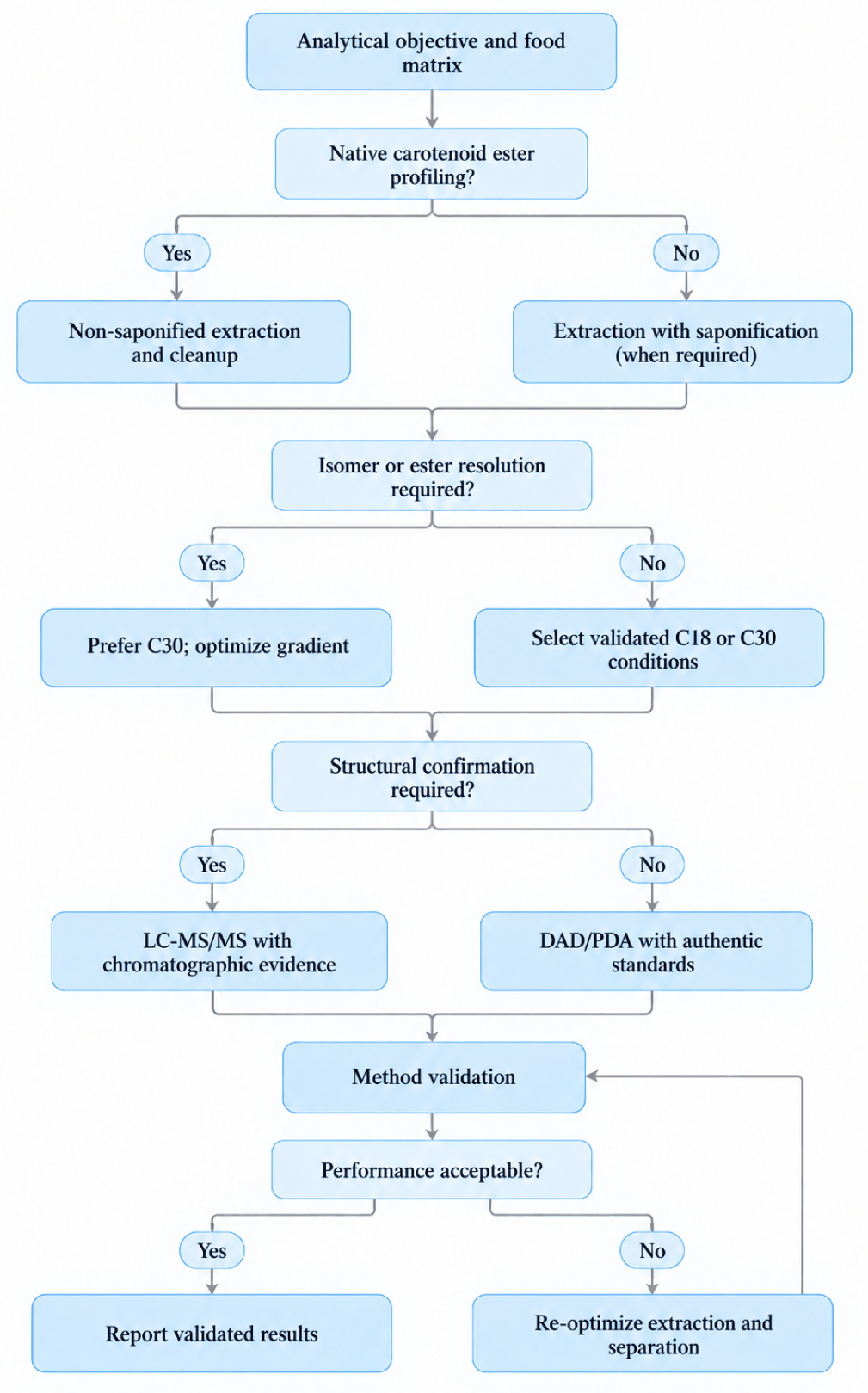
For quantitative carotenoid analysis, method validation is essential to ensure the reliability and comparability of analytical results across different food matrices. Commonly evaluated validation parameters include linearity, the limit of detection (LOD), the limit of quantification (LOQ), accuracy, and precision (Petry & Mercadante, 2018; Schimpf et al., 2018; Lee et al., 2025b).
Linearity is generally evaluated using calibration curves prepared with carotenoid standards, and the coefficient of determination is used to assess the relationship between analyte concentration and detector response. LOD and LOQ indicate method sensitivity and are particularly important for carotenoids present at low concentrations in complex food matrices. These values are commonly determined using either a signal-to-noise-based approach (Dias et al., 2008; Eriksen et al., 2017; Hostetler, 2017; Schimpf et al., 2018) or a calibration-curve-based approach (Strati et al., 2012; Jung et al., 2025; Lee et al., 2025b). Accuracy is commonly assessed by recovery tests, in which known amounts of carotenoid standards are spiked into samples and analyzed through the entire analytical procedure. Recovery is therefore useful for evaluating losses during sample preparation, extraction, saponification, chromatographic separation, and detection. In carotenoid analysis, recovery should be evaluated under matrix-relevant conditions because extraction efficiency and analyte stability may vary depending on the food matrix and sample treatment (Saini & Keum, 2018). Precision and repeatability are usually assessed by repeated analysis of the same sample or spiked samples and are expressed as relative standard deviation (RSD) values (Dias et al., 2008).
Because carotenoids are susceptible to degradation and isomerization, and because recovery can vary depending on extraction and matrix conditions, validation should consider the entire analytical procedure, from sample preparation and extraction to chromatographic separation and detection.
Conclusion
HPLC-based methods are useful tools for the analysis of carotenoids in foods, but their reliability depends on careful optimization of sample preparation, extraction, saponification, chromatographic separation, and validation procedures. Because carotenoids differ in polarity, molecular structure, isomeric form, and esterification state, analytical conditions should be selected and optimized according to both the target carotenoids and the food matrix. C18 columns can be effectively used for routine quantification of free carotenoids, whereas C30 columns are more suitable for the separation of structurally similar carotenoids, geometric isomers, and carotenoid esters. In addition, mobile-phase composition and gradient conditions should be optimized to achieve sufficient resolution. For carotenoid esters, MS-based detection is particularly important for structural confirmation because esterification does not markedly change UV-Vis absorption spectra, and commercially available standards for xanthophyll esters are limited. Food matrix characteristics, including moisture content, lipid content, acidity, pigment composition, and processing conditions, can affect carotenoid extraction efficiency, stability, and detection. Therefore, suitable analytical methods should be selected and optimized according to the characteristics of each food matrix. Because such matrix-dependent factors can influence analytical performance, validation parameters such as linearity, LOD, LOQ, recovery, precision, repeatability, and accuracy should be evaluated under matrix-relevant conditions. Overall, future studies should aim to establish standardized and matrix-specific HPLC-based analytical protocols to improve the accuracy, comparability, and applicability of carotenoid data in food analysis and functional food research.


